 CompanyMade in Detroit | Est. 2026
October 30, 2026
The Detroit Speakeasy Scene: Bootleggers, the Purple Gang, and Every Hidden Door Worth Finding Tonight
By Aali Qureshi, founder, Deadly Company
Short answer: The Detroit speakeasy scene is the living descendant of the Prohibition-era Windsor-Detroit Funnel, the smuggling route that carried an estimated 75% of America’s illegal liquor across the Detroit River. Detroit once held 16,000 to 25,000 speakeasies; today’s scene is smaller, legal, and still hidden in plain sight: unmarked doors, alley entrances and bars behind coffee shops, listed in full below, city by city, with how to get into each one.
Key takeaways
- Detroit was dry before America was: Michigan banned alcohol on May 1, 1917, nearly three years before national Prohibition, and the Windsor-Detroit Funnel was already running.
- An estimated 75% of all liquor smuggled into the United States during Prohibition crossed at Detroit, the river, Lake St. Clair and the St. Clair River.
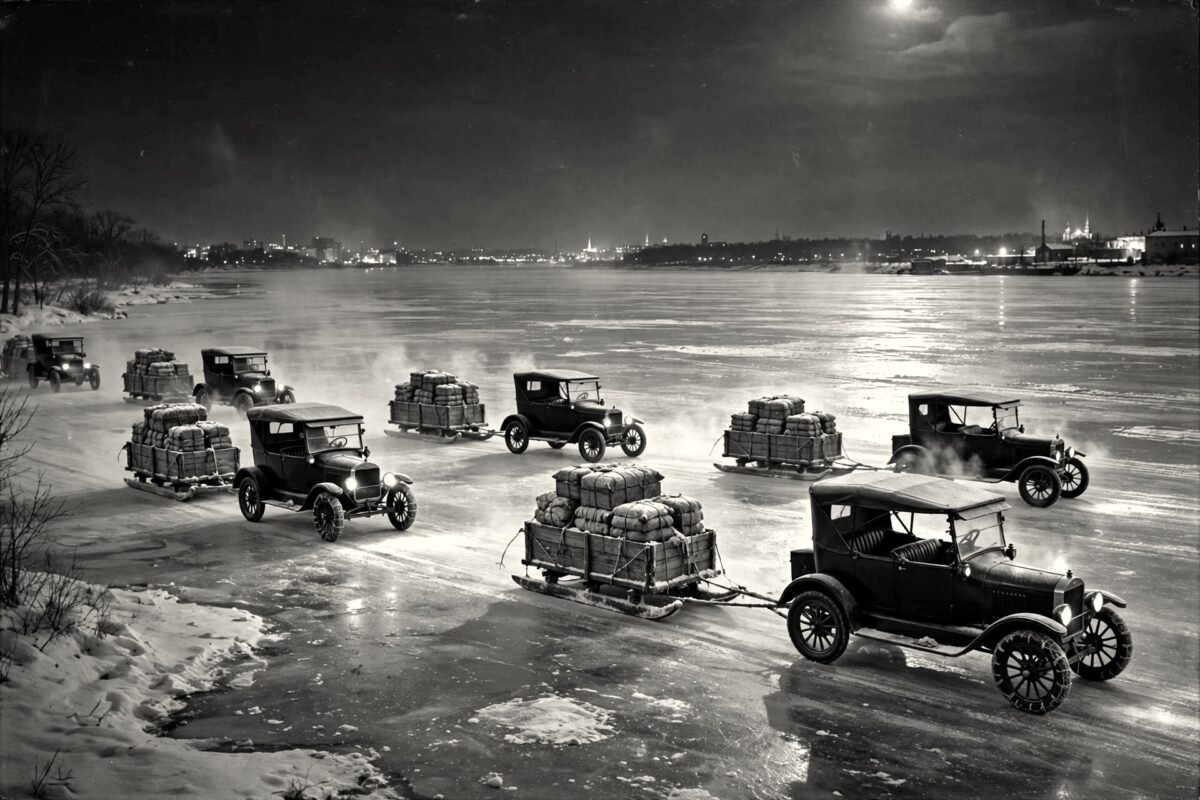
- In winter the river became a road: convoys of stripped-down Model Ts drove the ice towing sleds of Canadian whisky. The ones that didn’t make it are still down there.
- The Purple Gang, led by the Bernstein brothers, ran the trade so completely that Al Capone chose partnership over war.
- The modern directory, 34 joints from Detroit to Windsor, is below, every entry verified against public sources.
The Funnel
Stand on the Detroit riverfront and you can nearly throw a stone to Canada. Windsor sits less than a mile across: close enough that in 1917, when Michigan voted itself dry three years ahead of Washington, the supply problem solved itself in an afternoon. Ontario’s distilleries were legal. Hiram Walker, a Detroiter, had built his Canadian Club empire on the far bank at Walkerville precisely because he’d seen the temperance writing on the wall. The whiskey was right there. Only a river stood in the way, and the river, as Detroit would spend thirteen years proving, was not much of an obstacle.
Historians call the crossing the Windsor-Detroit Funnel, and the name undersells it. By the time national Prohibition arrived in January 1920, the Funnel was a mature industry with docks, warehouses, fleets and payrolls. Government estimates later put the flow at 75% of all liquor smuggled into the United States, through one river, past one city. By 1929, rum-running was Detroit’s second-largest industry, worth an estimated $215 million a year, behind only the automobile. Some 50,000 Detroiters worked the trade in one way or another. Detroit didn’t just drink during Prohibition. Detroit supplied the nation’s drink, and built an economy on the margin between a legal Canadian bottle and an illegal American one.
The Other Half of the Funnel: Windsor
Every story this page tells about Detroit starts on the other bank, because without Windsor, there is no story. Detroit had the thirst, the gangs and the market. Windsor had the whisky, and the paperwork that made it legal to produce. The Funnel had two halves, and the Canadian half ran on a legal fiction so elegant it deserves to be called what it was: the supply chain’s masterstroke.
Start with the man. Hiram Walker was a Detroiter, a grocer and grain merchant who watched Michigan’s temperance movement gather strength and, in 1858, moved his distillery across the river to the far bank, where he built not just a plant but Walkerville, an entire company town: housing, paved streets, streetcars, police and fire, running water, a town financed by whisky, decades before the whisky became contraband. His Club Whisky became Canadian Club when U.S. rules forced the country of origin onto the label: a naming change his American competitors demanded and he turned into the brand. Walker himself lived in Canada only four years; after that he commuted from his Hamtramck home on his own ferry. The Funnel’s founder was a cross-border commuter.
Then the fiction. Ontario went dry in 1916: the Temperance Act banned the sale of liquor in the province. What it never banned was manufacturing for export. It was illegal to sell a bottle in Windsor and perfectly legal to make a million of them there. From January 1, 1920, Ottawa permitted liquor exports to the United States on payment of a duty, with clearance papers, the B-13, declaring the cargo’s destination. The boats loaded at Windsor’s riverfront docks under papers stamped for Cuba, Venezuela, or “the high seas,” and crossed ten minutes of river. In Visit Windsor Essex’s phrase, “many boats seemed to be making four trips a day to ‘Cuba’.” When Ontario tried to shut the export warehouses down, a judge quashed the case in 1922: export was federal business, and Ottawa was content to tax it. Period estimates put the legal fiction’s throughput at over a thousand cases a day shipped from the Windsor-Detroit docks “bound to international locations,” with boat drivers making some $200 a day. Al Capone was among the distillery’s most important clients.
The operators matched the paperwork. James Cooper worked the loophole inside the loophole: nothing stopped an Ontario distillery from filling an order that originated outside Ontario, so Cooper opened a Detroit office, took Windsor customers’ orders by phone across the river, filled them from Windsor warehouses, and took a reported dollar a case, becoming one of Canada’s wealthiest bootleggers. Harry Low industrialised the crossing with large vessels running under Cuban and West Indian papers. And Blaise Diesbourg, “King Canada”, ran the Mexico Export Company out of Belle River: boat captains on his runs made $400 a month against $35 a month farming, whisky crossed the ice all winter (“It was like a highway out there,” he said later), and when the river and the roads weren’t enough, he smuggled by airplane: old bombers, twenty-five cases at a time, loaded at 6 a.m. regardless of the weather, in direct dealing with Capone.
The respectability didn’t survive the money. The Walker family sold the distillery in 1926, local-history accounts say the American Walker sons and grandsons were embarrassed to be seen as bootleggers, to Toronto whisky man Harry Hatch, who merged it with Gooderham & Worts and ran it, in the Oxford Companion’s words, openly as “a bootlegging hub.” The end came in stages, and all three stages were Canadian before they were American: Ontario legalised under government control in 1927 (the LCBO, with $2 permit books logging every purchase, and still no legal public drinking until 1934); Ottawa finally choked the export papers in 1930; and American repeal in 1933 killed the price that made the whole machine pay.
Here’s the part that isn’t history: the distillery never closed. The Hiram Walker plant in Walkerville is still operating today, still the largest beverage-alcohol distillery in North America, still making Canadian Club on the same riverbank. The old Canadian Club Brand Centre closed to the public in 2017 (don’t let an old guide send you there); the working distillery’s public door is now the J.P. Wiser’s Experience, running tours and tastings in the same complex. Walkerville is Windsor’s heritage district, and every August the city and Tourism Windsor Essex run an official Prohibition Week: distillery experiences, walking tours, a riverboat cruise, a riverfront speakeasy night. Detroit’s half of the Funnel hid. Windsor’s half put up a marker, and then a festival.
The Ice Road
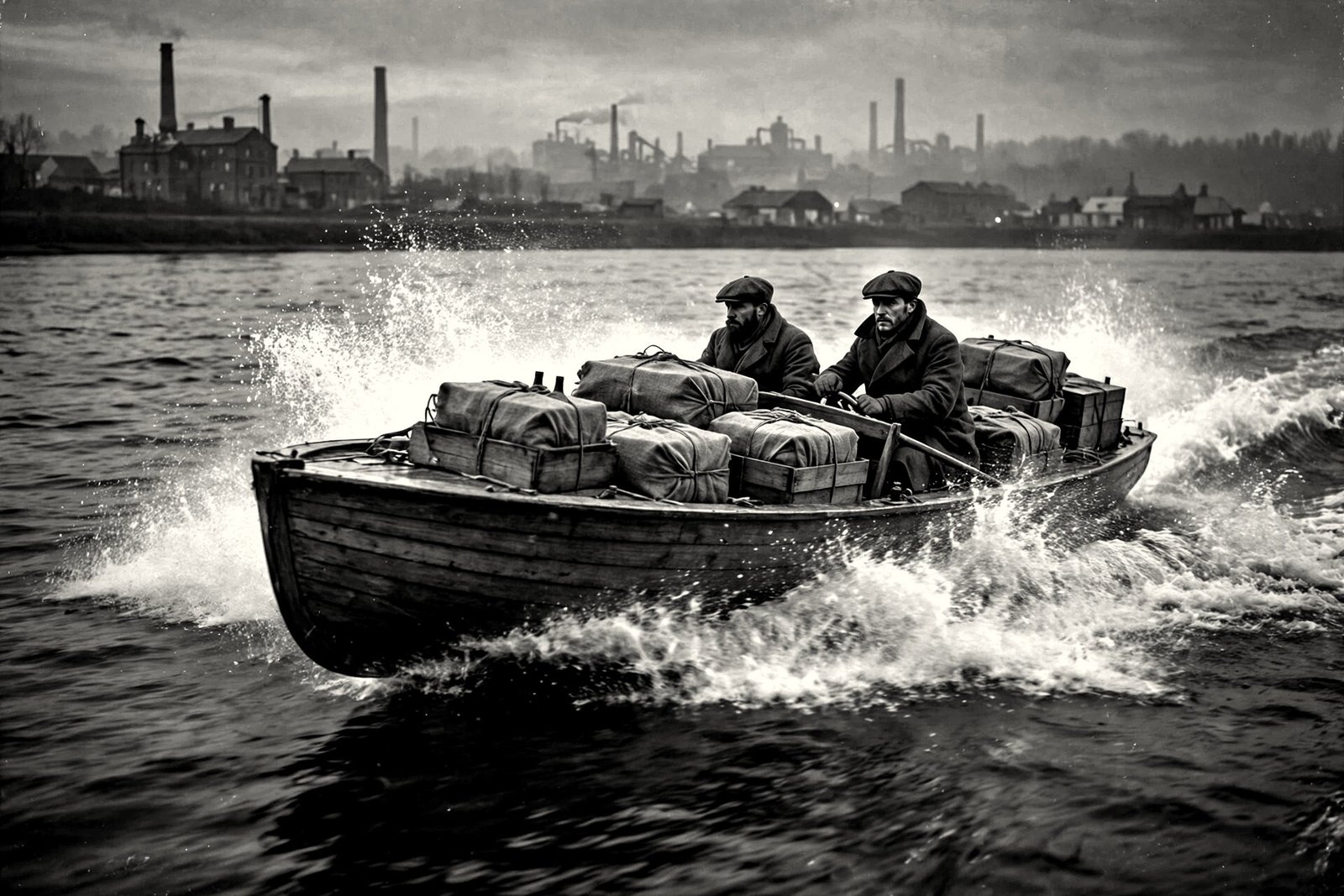
Summer belonged to the boats: speedboats planing across at dusk with burlap-wrapped crates, loads towed underwater beneath hulls, even, by some accounts, a pipeline laid from Windsor to a Detroit bottler. The Purple Gang’s river arm, a speedboat crew the police dubbed the Little Jewish Navy, treated the crossing like a ferry route.
Winter was stranger, and better. When the river and the lakes froze, the water became a highway. Men skated across dragging sleds piled with whisky. And the cars came: cheap Model Ts, bought for five or ten dollars, stripped of roofs and doors to save weight and give the driver a way out, creeping over the ice in convoys that could run to dozens of cars, headlights dimmed, each one towing a sled stacked with cases. Drivers crossed with one door open, ready to scramble if the ice spoke. Sometimes it did more than speak. Overloaded cars went through, and they stayed down: divers still find rum-runners’ Model Ts on the riverbed, one documented on film near the old Canadian Club plant with the chain for its trailer still attached.
Think about what that took. Not desperation, logistics. A supply chain run on nerve, in the dark, on ice, in the same city and the same decade that was perfecting the assembly line. The bootleggers were Detroit’s shadow auto industry: production on one bank, distribution on the other, and the Model T as the universal tool of both.
The Purple Gang and the Other Outfits
Every trade gets the management it deserves. Detroit’s was the Purple Gang.
They started as the Sugar House Gang: teenage toughs from the city’s lower east side, the Paradise Valley and Little Jerusalem neighborhoods, running errands and muscle for the older Sugar House distillers. Led by the Bernstein brothers, Abe and Ray, and a crew of reform-school alumni, the Purples graduated from errand boys to hijackers: instead of smuggling their own liquor, they simply stole everyone else’s, ambushing rival loads until the whole river trade understood that a cargo crossed under their protection or not at all.
By the mid-1920s the gang controlled liquor, gambling and more across Detroit, enforced with a violence that became national news. The 1927 Milaflores killings introduced Detroit to the Thompson submachine gun as a gangland instrument. When Chicago looked north, Al Capone, not a man known for diplomacy, decided the Purples were worth more as suppliers than as enemies, and partnered with them for his Canadian Club supply. Detroit’s gang exported to Chicago’s. Read that sentence again.
They weren’t the only outfit on the river. The Italian crews of the city’s east side were building what would become the Detroit Partnership. Irish, Jewish and Polish crews ran their own docks and routes, operators like the one they called King Canada ran truck, boat and plane loads out of Windsor, and thousands of ordinary families ran a case here, a boatload there: Prohibition in Detroit was a mass-participation economy. But the Purples were its flag.
What undid them was the usual thing: themselves. In September 1931, the gang murdered three of its own in the Collingwood Manor Massacre, and the city that had tolerated everything finally recoiled. Trials followed; the leadership went to prison; the river trade outlived them by barely two years. Michigan, fittingly, became the first state to ratify the 21st Amendment, and on December 5, 1933, Prohibition ended. The Funnel closed. The blind pigs turned into bars, or closed, or, in a few beloved cases, simply carried on being exactly what they had always been.
The Scene Tonight
Here’s the part the history books leave out: Detroit never lost the taste. A city that once counted twenty thousand speakeasies did not forget where the doors were. The modern Metro Detroit speakeasy scene is the Funnel’s legitimate grandchild, unmarked doors, alley entrances, bars inside coffee shops and behind elevator doors, except tonight the only thing being smuggled is you, past the ordinary, into a room that doesn’t advertise.
This is the full directory, broken down by city, with the only information that matters: where the door is, and how you get in. Everything below is publicly documented and verified. Doors change. Scenes move, and this page is kept current.
And because a map you can trust also says where the doors aren’t: we swept Livonia, Farmington, Farmington Hills, Canton and Ypsilanti hard, and there is no verified hidden bar in any of them, yet. Ypsilanti’s famous basement speakeasy, Keystone Underground, is long closed; Livonia’s Wintergarden Tavern ran a real one in 1932, but its basement is storage now. The sweep has since widened: Troy, Beverly Hills, Bloomfield Township and Bloomfield Hills, Mt. Clemens, Utica, Shelby Township, Sterling Heights, Warren and Clinton Township, and across the river Tecumseh, LaSalle and Amherstburg have all been swept the same way, and not one of them holds a qualifying hidden bar tonight. Shelby Township’s blind-pig history is genuine, but it lives in the history layer below, at McClenaghan’s. When a new door opens in any of those towns, it will land here.
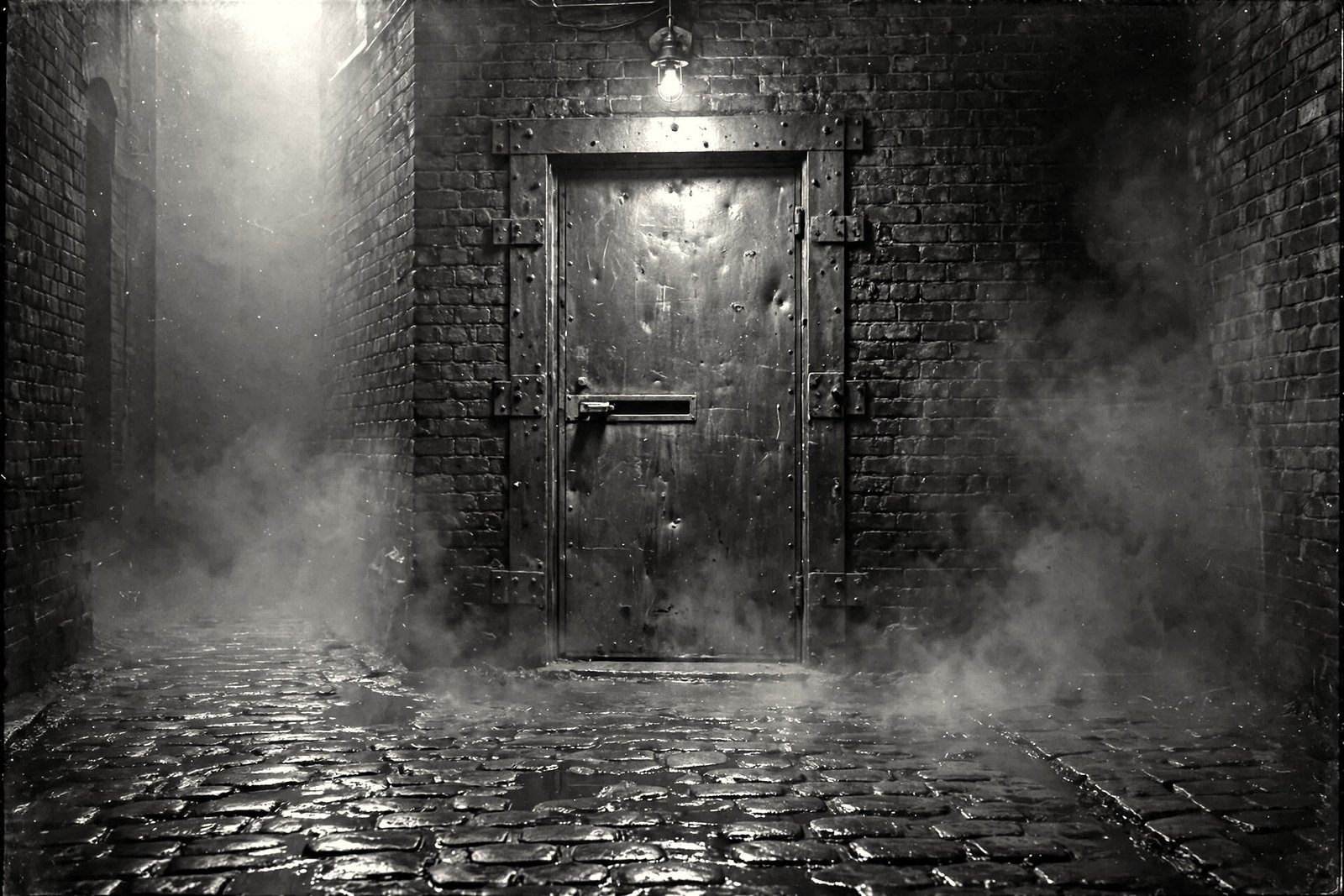
Detroit: Downtown
Shelby
Format: Drinks and small plates. Oysters and tartare from its own kitchen.
607 Shelby St (basement), Financial District. The door: no signage on the street. Go into Coffee Down Under and head to the back, downstairs, through a discreet blue door into a restored 1920s bank vault. Getting in: reservations via OpenTable are recommended, walk-ins are welcomed. The bar’s own direction is to head downstairs and tell the host you’re here to see Shelby. 18+. Known for: the Shelby Signature (Astral Blanco, lime, agave, manzanilla sherry) and a 2022 James Beard semifinalist nod for Outstanding Bar Program. Hours: Wed to Thu 5pm to 12am, Fri to Sat 5pm to 1am.
The Standby
Format: Full kitchen. A chef’s restaurant that happens to hide.
225 Gratiot Ave, The Belt. The door: there is no street entrance. The only way in is from The Belt alley, through a door set in an old elevator shaft. No sign. Getting in: reservations encouraged via OpenTable; walk-ins welcome, and the bar itself is first come, first served. Known for: a full cocktail bar and restaurant hidden in an alley, inventive drinks with a chef-driven kitchen, and a longtime pre-theatre stop for the Opera House crowd. Hours: Wed, Thu & Sun 5pm to 1am, Fri to Sat 5pm to 2am.
The Skip
Format: Drinks and small plates. Nachos, lamb pita and proper hot dogs.
1234 The Belt. The door: no door to find. The trick is finding the alley. The Skip is an open-air bar in the middle of The Belt, the mural-covered alley off Library Street; nothing of it is visible from the street. Getting in: walk in. No reservations, no list. Known for: frozen drinks done properly (the frozen Irish coffee) and seasonal full-alley takeovers, Sippin’ Santa at Christmas, Black Lagoon at Halloween. Hours: Tue to Thu & Sun 4pm to 12am, Fri to Sat 4pm to 2am.
Bad Luck Bar
Format: Drinks only. Eat before or after, somewhere else.
1218 Griswold St, Capitol Park: the address is Griswold; the entrance is not. The door: the entrance is in the alley behind the building, off State Street between Griswold and Woodward, a subtle gray door marked with a snake and a hand, and it stays locked. Getting in: knock, or call (313) 657-9177, and they’ll let you in. Tiny room, roughly 30 seats; parties of six or fewer. Sources conflict on reservations, the bar’s own copy says encouraged but not required, Visit Detroit describes call-ahead seating, so either way, call ahead. Known for: The Admiral, an experiential serve built on 1970 Black Tot rum, and a back bar of rare spirits including Pappy Van Winkle. Hours: listings conflict (a recent one shows Thu to Sat 4 to 11pm; older ones Mon to Sat from 5pm). Verify when you call, which the door makes you do anyway.
Café d’Mongo’s Speakeasy
Format: Drinks and small plates. The grilled cheese is the headline.
1439 Griswold St. The door: a plain Griswold Street frontage. Here the speakeasy is the room, not the door: a tiny, antique-cluttered space that has run on word of mouth since it reopened in 2007. Getting in: walk in only; expect a doorman and a wait on Friday and Saturday nights. Known for: two drinks invented here, the Detroit Brown (Crown Royal, bitters, Vernors) and the 1439 (rum and Faygo Rock & Rye), the grilled cheese, live music, and owner Larry Mongo holding court. Hours: Thu 5 to 11pm, Fri 5pm to 1am, Sat 7pm to 1am.
Evening Bar
Format: Drinks and small plates. Lobster rolls in a 45 seat room.
Shinola Hotel, 1400 Woodward Ave. The door: two ways in, through the Shinola Hotel lobby, or the discreet route, the Parker’s Alley entrance behind the hotel. Getting in: reservations on the bar’s website are recommended (they open 28 days out); walk-ins check in with the maître d’. Known for: a properly made Ramos Gin Fizz and the Smoke & Passion mezcal cocktail in a 45-seat room. Hours: Mon 5 to 11pm, Tue to Thu 5pm to 12am, Fri to Sat 5pm to 1am, Sun 5 to 11pm.
Room 1904
Format: Drinks and small plates. Tenderloin tips and bootlegger’s shrimp.
624 Brush St, Bricktown, above Jacoby’s. The door: walk into Jacoby’s, Detroit’s century-old German biergarten, and head up the stairs. The bar is the upstairs room, named for the year Jacoby’s was founded, and closed to the public for two decades before it reopened in October 2023. Getting in: reservations via Tock are the reliable route, proper attire is required, and public reviews report walk-ins seated when there’s room. Known for: the 1904 cocktail and a custom absinthe service. Hours: Thu to Sun 6pm to 1am.
Willow
Format: Drinks and small plates. Catfish fritters, wings and charcuterie.
1431 Times Square, beneath SavannahBlue. The door: under the soul-food restaurant, a golden door at the back, and you ring the doorbell to be let in. Getting in: walk in and ring, but read the house rules first, because Willow publishes them and means them: it’s a seated bar, 50 seats for 50 guests, visits run 90 minutes, groups over four need a reservation, phones are strongly discouraged, and gentlemen remove their hats. The blind pig had rules too. Known for: The Goat, the Willow Martini, and a Champagne Cobbler. Hours: Thu 6pm to 12am, Fri to Sat 6pm to 1am.
The Aladdin Sane
Format: Drinks only. The omakase here is cocktails.
Book Tower basement, 1265 Washington Blvd. The door: down in the Book Tower’s basement, next to Hiroki-San, behind a curtain. The bar’s own tagline is “Step behind the curtain.” Getting in: walk in for the lounge (nine bar seats plus lounge seating); the cocktail omakase, three or four drinks built like a tasting menu, is the reservation-worthy move. Known for: Detroit’s most extensive Japanese whisky list, per Eater Detroit, and a program named for the Bowie album. Hours: Tue to Thu 5 to 11pm, Fri to Sat 5pm to 12am (one listing adds Sunday, check before a Sunday visit).
Saksey’s
Format: Drinks and small plates. Shareable plates, caviar with Bugles.
1550 Woodward Ave, lower level of Gilly’s Clubhouse. The door: a bespoke alleyway entrance off Parker’s Alley, then down the stairs. You don’t enter through Gilly’s. Getting in: reservations via Resy; the room seats 55 across eight tables. Known for: Caviar & Bugles, a root beer negroni, and tableside mixology. The name honors Sam Gilbert’s 1970s Detroit bar: this room is a deliberate seventies revival, not a Prohibition costume, and it says so itself. Hours: Tue to Thu 5pm to 12am, Fri to Sat 5pm to 2am.
Hidden at Parlay Detroit
Format: Drinks and small plates. Elevated bites below the sports bar.
1260 Washington Blvd, lower level of Parlay Detroit. The door: underneath an 11,000-square-foot sports bar, event listings give the practical route: the side door off Grand River, then down. Getting in: this one runs on the calendar. The sports bar’s own events page stages “Discover Parlay Detroit’s Hidden Speakeasy” every Saturday, with ticketed R&B and themed nights other evenings via Passage and Eventbrite. Its own concept deck sets a no-phones rule inside. Known for: a full lounge program, live jazz, soul and R&B, named sections like “The Velvet Vaults”, hiding under the loudest room on the block. Hours: event-driven; Saturday programming weekly, event nights typically 10pm to 2am. Check parlaydetroit.com/events.
Detroit: Midtown & Corktown
Ghost Bar at The Whitney
Format: Drinks and small plates. The mansion’s dinner menu on request.
4421 Woodward Ave, Midtown, third floor. The door: walk into The Whitney mansion, tell staff you’re heading up to the Ghost Bar, and climb the main staircase to the third floor. Getting in: walk in, but seating is very limited (roughly five two-tops and ten bar seats), so go early or go on a weeknight. Known for: the Witching Hour Martini, absinthe drinks, live jazz and piano, and a haunted mansion’s worth of lore. Hours: the venue’s own listings disagree with each other, check thewhitney.com before you go.
Sugar House
Format: Drinks and small plates. Truffle popcorn and proper bar bites.
2130 Michigan Ave, Corktown. The door: honest framing. There is no hidden door. It’s a normal Michigan Avenue storefront, on this list because it effectively started Detroit’s craft-cocktail era, and because the name is the Prohibition artifact: it honors the Sugar House Gang, the Detroit outfit that trained the Purple Gang. Getting in: walk in Sunday to Thursday; Friday and Saturday, reserve through Tock. 21+. Known for: the 101 Classic Cocktails menu and a 300-plus-bottle whiskey program. Hours: Mon to Thu 5pm to 12am, Fri 4pm to 2am, Sat 3pm to 2am, Sun 3pm to 12am.
Jolly Old Timers
Format: Drinks and small plates. Fish fry, catfish and cheeseburgers.
641 W Forest Ave, Cass Corridor. The door: the bar is the lower level of a Victorian house. When the red light is on in the window, the club is open. Getting in: ring the doorbell and a member lets you in. Jolly Old Timers is one of Detroit’s oldest surviving Black social clubs, running in various forms since the 1950s, historically members-only, framed by Visit Detroit today as a find-it-and-you’re-welcome room. The story goes, and it is told as a story, that Coleman A. Young was once a member. Known for: the fish fry, cheeseburgers, bid whist, and seven decades of Black Detroit social history in one wood-paneled basement. Hours: listings conflict on the details but agree on the shape: evenings only, Mondays and Thursdays to Fridays, and the sign in the window is the final word.
Miss Eva’s Detroit
Format: Drinks and small plates. Seafood nights by Curt Got Crabs.
19566 Grand River Ave, Grandmont Rosedale. The door: the bar calls itself an “underground, Harlem-Renaissance inspired speakeasy” and plays the entrance as “behind closed doors”. No code or concealed-door mechanic is publicly documented beyond the branding, so none is printed here. Getting in: the calendar is the mechanic, in the bar’s own words, “Open on event days at 5pm, see calendar.” Owner Jay Williams, who grew up in the neighborhood, named it for his late grandmother, Eva Marie Franklin. Known for: a Harlem Renaissance listening room on Grand River: jazz, neo-soul and R&B, cocktails built on Black-owned spirits, and the signature “Curt Got Crabs.” Hours: event days from 5pm; no fixed nightly schedule, check the calendar.
Ferndale
The Oakland: Oakland Art Novelty Company
Format: Drinks and small plates. Bar bites, added quietly along the way.
201 W Nine Mile Rd. The door: a plain Nine Mile frontage whose glass door is lettered “Oakland Art Novelty Company”, the name drawn from the phony business fronts of the Prohibition era. Easy to walk past; that’s the point. And yes, it is still open: recent reports of its death are outdated. Getting in: mostly walk-ins; call-ahead seating recommended Fridays, Saturdays and for groups over four; themed pop-ups take online reservations for groups of 2 to 6. Known for: the Green Badu, a drinks program built on pre-Prohibition recipes, and full-room themed pop-ups, Miracle at Christmas, The Haunting at Halloween. Hours: Tue to Thu 4:30pm to 12am, Fri to Sat 4:30pm to 1am, Sun 4:30pm to 12am.
Mai Tiki
Format: Full kitchen. The TigerLily menu, served in the tiki room.
231 W Nine Mile Rd, inside TigerLily. The door: in the restaurant group’s own words, “Nestled behind an unmarked door in downtown Ferndale lies a hidden portal to an island getaway known as Mai Tiki”, through the sushi restaurant’s dining room. Getting in: walk into TigerLily and ask about Mai Tiki; reservations are taken, and the room books out whole for events. Known for: a full tiki program, the Painkiller, the Jungle Bird, a custom Mai Tai built on Doctor Bird rum, and crab rangoon from the TigerLily kitchen. Hours: listings conflict, long posted as Thu to Sat from 4pm, with recent coverage reporting expanded Tuesday to Sunday service. Check maitikibar.com.
Royal Oak
Johnny’s Speakeasy
Format: Full kitchen. Dinner, pastas and a prime strip.
215 S Main St. The door: the publicly documented mechanic isn’t the door. It’s the code. Getting in: reservation only, book on OpenTable or text the reservation line, (248) 794-1261. Parties of 1 to 6, 21+, two-hour table limit, and the secret entry code is sent to you the afternoon of your reservation. This is the real Prohibition mechanic, run properly: no reservation, no code, no entry. Known for: a back bar its listing puts at 669 unique spirits, a French 75 built with Empress gin, and live jazz on some nights. Hours: Thu 6pm to 12am, Fri to Sat 6pm to 1am, Sun 5 to 11pm.
Clawson
Weiss Distilling Co.
Format: Drinks and small plates. Caviar service and charcuterie only.
34 E 14 Mile Rd. The door: the best door on this list. Enter from 14 Mile through the liquor-cabinet-style retail shop, then step through the central working elevator and come out in a hidden 40-seat speakeasy: the elevator is real, and also serves the upstairs theatre. Getting in: reservations recommended (booths book online via OpenTable); bar seats are walk-in, first come, first served. Known for: cocktails composed almost entirely of products made on-site, house spirits, syrups, bitters, sodas and ice, and seasonal full-room takeovers like HalloWeiss. Hours: Tue to Thu 5 to 11pm, Fri to Sat 5pm to 12am.
The Viridian Room
Format: Drinks and small plates. French plates from the bistro kitchen.
230 S Main St, inside French Toast Bistro. The door: a cocktail room concealed inside a daytime brunch bistro, in the bar’s own words, “Hidden behind the door. Found only by the curious.” Getting in: book it like a secret. DM the bar on Instagram, or reserve through French Toast Bistro on OpenTable; it’s also on Resy. Known for: craft cocktails like the “Sting Like a Bee,” with French small plates from the bistro kitchen. Hours: Fri to Sat 6 to 9pm only, per its listing, two short nights a week, so book ahead and confirm before you go.
Rochester
The Eastman
Format: Drinks and small plates. Charcuterie boards and house made bites.
336 S Main St, underneath Dessert Oasis Coffee Roasters. The door: down. The Eastman is a roughly 30-seat cocktail bar in the basement of a Main Street building, coffee roasters above it, a barber shop, Kingsfield Grooming, in the same stack, reached from the East alley between Third and Fourth Streets, named for Jefferson Eastman, the man who built the building. Getting in: walk in and grab a seat. The bar takes no reservations, full stop. Known for: a Tales of the Cocktail Top 10 honour for Best New Cocktail Bars in the U.S. Central region, seasonal reinvented Prohibition recipes, and the Thurston, the drink the regulars will tell you to order. Hours: Tue 5 to 10pm, Wed to Thu 5 to 11pm, Fri to Sat 5pm to 12am or later; closed Sun to Mon.
Baus Barber
Format: Drinks only. A haircut, a cocktail, no kitchen.
114 E 4th St. The door: the barber shop itself. By day Baus is a working barbershop, cuts and beard trims; by night the same room pours cocktails until late, live music included. No basement and no password: the disguise is the day job. Getting in: walk in. Known for: Empress gin martinis and the egg-white drinks the regulars swear by. Hours: Mon to Thu 10am to 12am, Fri 10am to 2am, Sat 9am to 2am (shop and bar share the listing).
Northville
NOMI Lounge
Format: Drinks and small plates. A chef’s rotating small plates menu.
133 W Main St. The door: the lounge’s own direction says it all, “Follow the beat to the red light and velvet ropes.” It bills itself, in its own site title, as “Northville Michigan’s Speakeasy,” an art-deco room at the Northville Sports Den’s Main Street address. Getting in: walk in, its own site promises “No lines. No cover.” Reservations are taken; go on a live-music night. Known for: live bands in two sets, dueling pianos, cover bands, burlesque nights, craft cocktails with a zero-proof program, and a rotating small-plates menu. Hours: Wed to Thu 5pm to 1am, Fri to Sat 5pm to 2am.
Plymouth
The Ebenezer
Format: Drinks and small plates. Wagyu sliders and a lamb shank.
305 Fleet St. The door: the basement of the former First National Bank of Plymouth. The building above is now The Ledger restaurant, and in the bar’s own words it sits “hidden in plain view off Fleet Street.” The bank’s vault survives inside as the private tasting room, member lockers and all. Detroit’s Shelby is a bank vault; Plymouth answers with a whole bank basement. Getting in: walk in, or reserve via OpenTable. At 4,000-plus square feet and room for 127, the secret here is the location, not the squeeze. Known for: rare bourbons, the Three Wolf Moon, and wagyu sliders. Named for Ebenezer J. Penniman, the bank’s first president, appointed in 1871. Hours: Sun 5 to 11pm, Tue to Thu 5pm to 12am, Fri to Sat 5pm to 2am; closed Mon.
St. Clair Shores
The Best Kept Secret
Format: Drinks only. Pours from the store next door.
22425 Harper Ave, inside the Wine Garden liquor store. The door: the strongest hidden-inside-a-business mechanic in the suburbs, a speakeasy tucked inside a working liquor store. Reviewers describe slipping past the beer cooler; the bar’s own site keeps it simpler: “Look for the discreet entrance tucked within the liquor store… Ask a clerk for the secret entrance.” Getting in: reservations via Tock are “strongly recommended”. Tables are held 90 minutes, there’s no standing room, it’s 21+, and there is a dress code: closed-toed shoes, a collared shirt, pants, no gym attire. Known for: handcrafted old fashioneds and a serious bourbon shelf, and “From Shelf to Glass”: a bottle you love at the bar can be bought in the store on your way out. Hours: Wed to Thu 4 to 10pm, Fri to Sat 4 to 11pm.
West Bloomfield
Knock Twice Speakeasy
Format: Full kitchen. Turkey tacos, catfish and brunch pancakes.
6430 Farmington Rd: yes, Farmington Road; no, not Farmington Hills. It’s West Bloomfield Township. The door: honest framing again. No code, password or concealed door is publicly documented. What it has is the name, the concept (it calls itself “A Modern Speakeasy”), an unsuspecting exterior, and a reviewer on its listing writing that “this place holds true to the speakeasy title.” Getting in: reserve, tables run on 90-minute seatings through its site and OpenTable, and live-music nights fill the small room. Known for: live R&B bands, the Top Nach strawberry martini, and a real kitchen, Turkey Taco Trio, catfish and grits. Hours: Wed to Thu 5pm to 12am, Fri to Sat 5pm to 1:30am; closed Sun to Tue.
Birmingham
Rose Room at 220
Format: Drinks and small plates. Craft cocktails and light plates.
220 E Merrill St, lower level, downtown Birmingham. The door: honest framing, stated plainly. No unmarked door, password or concealed entrance is documented here; the concealment is vertical only, a lounge in the lower level of the historic Detroit Edison building, beneath the 220 Merrill restaurant. The venue’s own copy calls it an “intimate, underground party place,” and this page carries it on the same terms as Windsor’s Funky Chow: downstairs, under its own name, there if you know to look down. Getting in: walk in on its open nights; its own site’s calendar lists ticketed Friday event nights, the Fridays at Rose Room series, running through December 2026. Known for: a Vegas-inspired ultra lounge: world-renowned DJs, interactive light shows, bottle service, craft cocktails and light plates, with a grand piano on stage. No signature drink is documented. Hours: Fri to Sat 9pm to 2am, per the venue’s own description. One places aggregator flags the room “Temporarily Closed”; its own site is live and listing events, and on this page the venue’s own site governs.
Howell
2FOG’s Pub
Format: Full kitchen. The Tuskers burger, shrimp and grits.
118 W Grand River Ave. The door: the pub is in the basement of the Heart of Howell building, and its only entrance is around the back. The bar’s own directions: park behind the building, look toward Grand River for the wall with the farm mural, go left of the mural, and take the stairway down. Pure Michigan’s hidden-speakeasies roundup gives the same wayfinding, find the mural, find the door. Getting in: walk in. The whole game is finding it. Known for: its own line says it, “Howell’s only uptown downstairs place to meet”, plus the Tuskers Burger (elk, bison and beef), Michigan microbrews, and an expansive whiskey list in a warm brick-walled basement. Hours: Sun 10am to 7pm, Mon to Thu 11am to 10pm, Fri 11am to 11pm, Sat 12 to 11pm.
Ann Arbor
The Last Word
Format: Full kitchen. Truffle fries and short rib poutine.
301 W Huron St. The door: its own inconspicuous entrance off Huron Street: a plain door, easy to walk past, with a low-lit 1920s room behind it. Getting in: reservations via Tock are strongly recommended. Bookings run in two-hour windows and the room is often fully booked; walk-ins wait at the door for space. Known for: its namesake, the Last Word (gin, green Chartreuse, maraschino, lime), a cocktail created at the Detroit Athletic Club in 1921 and revived here as the house standard. Even Ann Arbor’s best door pours a Detroit invention. Hours: Mon 5pm to 12am, Tue to Thu 5pm to 1am, Fri to Sat 5pm to 2am, closed Sun.
Babs’ Underground
Format: Drinks only. Chips and hummus is the whole story.
213 S Ashley St, basement of the Schwaben Building. The door: a discreet entrance on Ashley Street takes you down into the basement lounge. The bar’s own site calls it one of Ann Arbor’s best-kept secrets, and it’s been kept since 2004. Getting in: walk in. In the bar’s own words: “We do not accept reservations other than full venue rentals.” Known for: espresso martinis, rare bourbons and single malts, and two regulation pool tables, free pool on Tuesdays and Sundays. Hours: 7pm to 2am, every day.
Windsor, Ontario
And tonight? The honest asymmetry of the whole list: Detroit hid its drinking in bars; Windsor hid its liquor in warehouses and paperwork, so the modern Windsor scene is thinner: one true speakeasy-format bar, one tiki bar hidden inside a restaurant, and two honest-framing entries, in the tradition this page has kept all along. The list ends where the liquor started.
Blind Owl
Format: Drinks and small plates. Charcuterie built for the wine list.
430 Ouellette Ave, downtown Windsor. The door: an unlabeled door just to the right of the Four Points by Sheraton on the city’s main street. Reviewers repeat the same wayfinding because there is no sign to find: “it’s a speakeasy so it’s not easy to find.” Getting in: walk in. It’s a small room, so arrive early to secure a spot. Known for: Windsor’s benchmark cocktail bar: the Tiger Knee (Irish whisky, Amaro Montenegro, lemon, ginger syrup), a smoked hazelnut old fashioned, and themed cocktail workshops. Hours: Thu 7 to 11pm, Fri to Sat 7pm to 12am.
Funky Chow Kitchen
Format: Full kitchen. A restaurant first: bao, sushi, noodles.
2090 Wyandotte St E (lower level), Walkerville. The door: honest framing. No password, no concealed entrance; the concealment is vertical. The restaurant sits in the lower level of its building, and Tourism Windsor Essex’s own cocktail guide calls it “this underground restaurant tucked away in Walkerville.” Getting in: walk in or reserve, a restaurant first (Asian-fusion tapas, sushi, bao) with a serious cocktail program attached. Known for: the Voltaire No6, the Kokonatsu (coconut tequila, Aperol, lime and coconut cream), sake flights, and, for the city’s Prohibition Week, a house cocktail called The River Runner, named for the men who crossed this river with the whisky. The Funnel, on a menu, half a mile from the docks. And hidden inside this same restaurant sits a second bar, IKTO, which gets the next entry, if you can find it. Hours: Mon to Thu 5 to 9pm, Fri to Sat 5 to 11pm, Sun 4 to 9pm.
IKTO (I Know The Owner) Tiki
Format: Unverified. Nothing public puts food in the tiki room.
Inside Funky Chow Kitchen, 2090 Wyandotte St E (lower level), Walkerville. The door: confirmed to exist, placed, and deliberately not described. IKTO is a tiki bar hidden inside Funky Chow, and its entrance is documented only as a secret: the bar’s own site offers no wayfinding beyond “Come find us!”, Tourism Windsor Essex calls the room “tucked away, in an almost ‘speak-easy’ sort of way,” and the W.E. Roundup’s August 2026 Hidden Bars edition says guests “step through its playful, secret entrance.” What that entrance actually is, no public source says, and this page declines to invent one. The finding is the point. Go and be the one who finds it. Getting in: through Funky Chow Kitchen; the room keeps its own hours and takes its own reservations, for parties of up to four, through its site. Known for: being the bar most of Funky Chow’s own diners never see. You can eat a whole meal at Funky Chow, pay, and leave, and never know a second bar was in the building with you. The name is the joke, spelled out on its own site: IKTO, I Know The Owner. Its documented pour is the Mermaid Punch, its Singapore Sling take, poured for the city’s Prohibition Week. Hours: Thu 6pm to 10pm, Fri to Sat 5pm to 1am, Sun 4pm to 9pm, per the bar’s own site. One listing disagrees on the Sunday hours and gives the building’s Argyle Road side address instead; the hours above are the bar’s own.
Maiden Lane Wine & Cocktail Bar
Format: Drinks and small plates. Boards, burrata and tinned fish.
494 Pelissier St, at Maiden Lane, downtown Windsor. The door: honest framing again. A signed storefront, included for where it sits: a small bar tucked onto Maiden Lane, downtown’s mural-covered lane, the kind of address you walk past for years; reviewers consistently call it a hidden gem. Getting in: walk in; reservations taken. Known for: the bar that set Windsor’s modern cocktail standard. Classics like the Aviation and the Paper Plane beside house drinks like the Pigeon Nail and the Sinesis (Amaro Nonino, Grand Marnier, mezcal and Campari), plus a bottle shop stocking bottles the LCBO doesn’t carry. Its Prohibition Week pour is The Variant, built on Lot No. 40: Walkerville whisky, in a Windsor lane, for the city’s Prohibition party. Hours: Tue to Thu 5 to 11pm, Fri 5pm to 1am, Sat 6pm to 1am.
The year-long version: a determined couple, or a crew of friends with a group chat and no quit, can visit every door on this page in a single year. We built the route: One Year of Hidden Bars and Speakeasies Tour. Three doors a month, Windsor in August, and a New Year’s Eve finish in a bar that was a real blind pig.
Gone, and Worth a Toast
A directory that only lists the living is a directory that’s lying about the dead, so for the record: Willis Show Bar, the Cass Corridor revival of a Detroit legend, closed in July 2025. Castalia at Sfumato, Midtown’s fragrance-and-cocktails jewel box, poured its last on December 31, 2025. Lost River, the Morningside tiki bar, closed in 2023: its room is now a wine bar called Fourth Wall. If an older list sends you to any of these doors, the list is stale. This one gets re-verified quarterly.
Where the Blind Pigs Were
Now the ghosts. The rooms below served illegally during Prohibition, and the buildings survive, but the speakeasy itself is gone: it’s a banquet hall now, or a storage basement, or somebody’s apartment. You can stand where the blind pig stood. In most of these, you cannot order a drink, and where you still can, because the bar simply never left and got itself a license in 1933, that’s labeled too. Detroit keeps its history the way it keeps everything: in use, or in the walls.
Blossom Heath Inn: St. Clair Shores
24800 Jefferson Ave. Then: the glitziest speakeasy on the Jefferson strip, and we don’t have to take anyone’s word for it, because the Michigan state historical marker in front says it: gambling upstairs and in the basement, a buzzer on the stairway’s newel post so the doorman could warn the rooms when federal officers arrived, and a back door in the basement where rum-runners brought Canadian whisky in by boat after dark. Big bands played the ballroom; the Funnel ended at this dock. Now: an events and banquet venue, the ballroom, the circular dance floor and the mahogany bar survive, restored. You can stand in the room where the boats unloaded. You cannot walk in and order a drink. Verified against the state historical marker, October 2026.
Little Harry’s: Detroit
624 Third St, under today’s Tommy’s Detroit Bar & Grill. Then: a basement blind pig run by Harry Weitzman, a man with rumored Purple Gang ties, in Third Street Gang turf. Now: this is the rare rumor archaeologists got to test: in 2013 Wayne State University dug the basement and documented a bricked-up tunnel, a sealed “false room” with no entrances or windows, period liquor bottles, and business cards naming the speakeasy. The sports bar upstairs is open to anyone; the false room stays sealed, and basement tours are not on offer. The evidence is in the ground, and the ground is keeping it. Verified against Wayne State University’s Ethnic Layers of Detroit, October 2026.
Wintergarden Tavern: Livonia
33320 W. Seven Mile Rd. Then: opened in 1932, still Prohibition, by a Detroit police officer named Bill Winters: a restaurant on the first floor, and, per the City of Livonia’s own 2024 architectural survey, “a small speakeasy with a makeshift bar in the basement,” reached by a staircase just inside the front door, admission by word of mouth among family and friends. The current owners pass the story down with their own honest caveat, it “probably includes elements of rumor”, but the city’s survey prints it as the building’s history. Now: an ordinary, operating tavern, Livonia’s oldest bar. The speakeasy is under your feet: the basement is storage today, the stairs covered over beneath the entryway floor, the marks of the bar still on the wall. Lunch upstairs runs over a blind pig you can’t visit.
Ye Olde Tap Room: Detroit, at the Grosse Pointe Park Line
14915 Charlevoix St. Then: per Detroit drinking historian Mickey Lyons, the Tap Room “only served alcohol legally for a year or so before Prohibition started”, and then, in Lyons’ account, operations “continued unabated underground”: a full bar below, a dumbwaiter, the ground floor given over to a trolley comfort station, and a second-floor gaming room with a built-in lookout bench. Now: the ground-floor bar still pours (the beer list is famous), but the second and third floors, the gambling rooms, are private apartments. The part of the building that ran the game is somebody’s living room now. Verified against Hour Detroit’s bar-history reporting, October 2026. Windsor material verified against Visit Windsor Essex, the Oxford Companion to Spirits and Cocktails, U.S. State Department historical records, period Detroit Free Press reporting, the Windsor Star, and the bars’ own sites, October 2026.
Hamtramck: the City That Was a Blind Pig
Hamtramck Historical Museum, 9525 Jos. Campau. Then: not one building, a whole city. The Hamtramck Historical Commission’s chairman documents it: in 1920 the city of 48,000 “almost immediately became a center of the illegal liquor trade… Speakeasies were everywhere, barely concealed,” until the Michigan State Police took over local law enforcement in 1923 and raided to little effect; stills were still being found in Hamtramck houses and garages into the early 1960s. Now: no single blind-pig building is publicly identified, which is its own kind of honesty, so the anchor is the museum, where a genuine confiscated Prohibition still, recovered from a Hamtramck building, sits in the front window. The whole town was the speakeasy. The still is what’s left on display.
Frank’s Eastside Tavern: Mt. Clemens
126 Avery St. Then: a 15-by-30-foot basement dug under a 1909 farmhouse, head-banging ceilings and all: per the bar’s own published history, echoed by Hour Detroit, when Prohibition came “the covert basement bar [was] an ideal location to sneak a drink without the feds knowing your business,” and it supplied the neighborhood for all thirteen years. Now: the honest exception to this whole section, the blind pig never left. On repeal it took the name Eastside Tavern, in 1933, and, per the Detroit Free Press, Macomb County liquor license No. 1, the first issued after Prohibition and still the oldest liquor license in the county. It’s still a working bar in the same basement, run by fourth-generation owner Heather DeBruyn, who took over in 2017; the bar’s own history page still names Frank DeBruyn, who bought the farmhouse in 1991. Its hours carry the other open question: the bar’s own site publishes none, and listings split on the Wednesday and Thursday closing, 11pm or 11:30pm against midnight, so the conflict is printed here rather than resolved. You can drink in this one. Legally, this time.
McClenaghan’s Pub: Shelby Township
52500 Van Dyke Ave, in Disco, the lost village south of 24 Mile Rd. Then: Shelby Township’s own official history, at shelbytwp.org, says it plainly, in two places: during Prohibition the current McClenaghan’s, formerly Ichabod’s, “was a blind pig called the Yellow Canary when Disco was known as whiskey center,” and a half barrel of beer was obtainable from a Utica distillery for $8. The township’s historical timeline repeats the account, and 24 Mile Road itself was once known as Whiskey Road. Metromode’s survey of metro Detroit’s oldest bars carries the same story with an honest caveat that travels with it here: this is “another former blind pig, albeit with a less documented paper trail.” No raid report, court record or period newspaper item turned up in our research, so the claim rests on the township Historical Committee’s account, and it is printed as exactly that. Now: a signed Irish pub, still pouring on Van Dyke, known for hand-pressed burgers and fried pickle chips, with nothing hidden about it at all. This is a history entry, not a door to find: the Canary sang a century ago, and the building kept the address.
Two Way Inn: Detroit
17897 Mt. Elliott St. Then: the building had already been a general store, a stagecoach stop, a hotel and the village jail before Prohibition. Per the house’s own history, retold by the family that has owned it since 1973 and repeated by Visit Detroit, the dry years were run behind a brilliant front: a dentist’s office, a cover with a legal purpose, since the Volstead Act let dentists prescribe up to a pint of whiskey every ten days, while the bar did its quiet work in the rooms around it. Printed as the house tells it, because that’s the sourcing. Now: still an operating neighborhood bar, and one of only two surviving original Stroh’s tied houses in Detroit.
Abick’s Bar: Detroit
3500 Gilbert St. Then: opened 1907, and here’s where the evidence is physical. In the fall of 2016, the sixth-generation owner pulled a removable panel in the men’s room and found a crawl space nobody alive knew existed, holding two Prohibition-era whiskey barrels under a century of dust, one of them still full, with period bottles and crates. Because barrel distribution ended by 1933, the cache dates to the dry years. The barrels are fact; that Abick’s ran as a speakeasy is the house’s history plus a strong inference, and it’s printed that way. Now: an operating family dive: 1911 cash register, tin ceiling, original Stroh’s bar. The crawl space is not an exhibit. Verified against Hour Detroit’s reporting of the find, October 2026.
Nancy Whiskey: Detroit
2644 Harrison St, Corktown. Then: established 1902. The bar’s own website tells it plainly: it survived “through the Prohibition (once had its own speak easy!)” and a devastating 2009 fire, and still holds one of Detroit’s oldest liquor licenses. No independent documentation turned up in our research, so this one stands exactly as labeled: the house’s own claim, carried by the house for a century, and repeated, as a claim, by the Detroit Free Press. Now: an operating Irish dive, still pouring under that license. Verified as a house claim, October 2026.
Tom’s Tavern: Detroit
10093 W. Seven Mile Rd. Then: built in 1928 by Greek immigrant Tom Lucas as an ostensible lunch counter: sandwiches on the counter, the real business behind them, per historian Mickey Lyons; the Purple Gang limo deliveries are, in Lyons’ own words, a rumor that persists, “entirely possible, if tough to prove.” Now: closed, the bar shut in 2018 after co-owner Ron Gurdjian’s death, and Hour Detroit confirms it never reopened. No current source confirms whether the little plywood building itself still stands, so this is the section’s quiet ending: a blind pig whose room may already be gone, remembered in print because the record is all that’s left.
Dominion House Tavern: Windsor
3140 Sandwich St, Olde Sandwich Towne, Windsor. Then: the border region’s oldest continuously run tavern: a hotel on the site from 1859, licensed since 1869, in its current building since 1883, and it traded straight through Prohibition, sheltering Ambassador Bridge construction workers as the bridge rose beside it in 1927 to 1929. Hour Detroit describes “a storied past of rumored Prohibition-era rum-running”: rumored is the operative word. The legend says rum-running tunnels run from the basement; the tavern’s own co-owner told the Windsor Star he was told the same thing and couldn’t find any. Both are printed here, because both are the record. Now: still an operating English-pub-style tavern in a heritage-designated room. The reverse of Frank’s Eastside across the river: this one never hid and never left, and the rum-running chapter is lore attached to a documented survivor. You can drink in this one too. Its hours, if you go, are a local argument: current listings close it anywhere from 11pm to 2am, so the disagreement is printed here and the hours are not.
Sidebar: Metzger’s, Ann Arbor: not a speakeasy, and included precisely because it isn’t. In 1929, at the German American Restaurant on West Washington, founder Wilhelm Metzger was prosecuted for selling hard cider: fined $100, five years’ probation, forbidden to leave Michigan without the court’s permission. The family’s own version says the cider “had inadvertently fermented.” Both framings are in the record; the $100 fine is the little man’s Prohibition, and it deserves its line. Metzger’s still serves today, fourth-generation, at a different address on Zeeb Road. The corner where Wilhelm got pinched isn’t the restaurant anymore.
Lost entirely: the Collingwood Manor apartment building on Collingwood Avenue, site of the 1931 massacre that broke the Purple Gang, has been demolished; there’s nothing left to stand in front of. And Downriver, the Ecorse waterfront strip they called Hogan’s Alley, boathouses converted to liquor storage, cottages to gambling houses, through which a local paper of the era reckoned 90 percent of Michigan’s Canadian liquor passed, survives as a shoreline, not an address. Some of the map is just water now. Which is, when you think about it, where most of the Funnel always was.
What to Wear to a Door That Doesn’t Exist
The original rule of the blind pig was simple: look like you belong, and nobody asks questions. It still works. The modern uniform is the one our Syndicate world was built on: black, clean, quiet, nothing that shouts. If you’re making a night of this list, dress like the room is already yours: the D.Co Syndicate collection was designed for exactly this side of the city.
Detroit built the cars, the sound, and, for thirteen glorious years, the supply. The doors are still here. Now you have the map.
Deadly Company is a Detroit lifestyle company. We write about the city that made us: its muscle, its music, its hidden rooms. This page is re-verified quarterly.
Frequently Asked Questions
What was the Windsor-Detroit Funnel?
The smuggling route across the Detroit River, Lake St. Clair and the St. Clair River between Windsor, Ontario and Detroit during Prohibition. An estimated 75% of all liquor smuggled into the United States crossed here.
Who were the Purple Gang?
A Detroit organized-crime syndicate led by the Bernstein brothers that dominated the city’s Prohibition liquor trade in the 1920s, supplying even Al Capone’s Chicago organization, until the Collingwood Manor Massacre of 1931 brought the prosecutions that broke it.
Did bootleggers really drive cars across the frozen Detroit River?
Yes. In winter, convoys of stripped-down Model T Fords, some towing sleds of whisky cases, crossed the ice of the Detroit River and Lakes St. Clair and Erie. Cars that went through the ice remain on the riverbed and have been documented by divers.
How many speakeasies did Detroit have?
In 1928 the Detroit News estimated between 16,000 and 25,000 speakeasies and blind pigs operating in the Detroit area.
Are the speakeasies on this page legal?
Yes, every spot in the directory is a licensed, operating bar. The Prohibition styling is heritage; the liquor is legal now. Entry details are publicly documented and re-verified quarterly.
What is the hardest speakeasy to get into in Metro Detroit?
Johnny’s Speakeasy in Royal Oak: it is reservation-only, and the secret entry code is texted to you the afternoon of your reservation. No reservation, no code, no entry.
History sources: Walter P. Reuther Library, Wayne State University: Prohibition in Southeastern Michigan; NPR: Detroit Returns to Its Prohibition-Era Whiskeytown Roots; Visit Windsor Essex: Prohibition; Divernet: the rum-runners’ Model T. Directory entries verified against the bars’ own sites, Eater Detroit, the Detroit Free Press, Hour Detroit, Visit Detroit and booking-platform listings, October 2026. Historic sites verified against the Michigan state historical marker for Blossom Heath Inn, Wayne State University’s Ethnic Layers of Detroit project, the City of Livonia 2024 Architectural Survey, the Hamtramck Historical Commission, and Hour Detroit’s bar-history reporting, October 2026. Windsor material verified against Visit Windsor Essex, the Oxford Companion to Spirits and Cocktails, U.S. State Department historical records, period Detroit Free Press reporting, the Windsor Star, and the bars’ own sites, October 2026.
34 Doors: the story
The doors have a story now.
Seven friends. One notebook. Thirty-two hidden Detroit doors, from Halloween to Christmas. The tour became a story. Read it as it unfolds, a door at a time.