 CompanyMade in Detroit | Est. 2026
34 Doors
Episode 0: The Door Before the Doors
My name is Sam. I pour drinks for a living.
I have poured, at one bar or another, for every person in this story, separately, for years. They have all talked to me. People talk to bartenders. They tell us the parts they tell nobody else, in pieces, at last call, and they do it because a bartender’s first professional skill is forgetting on purpose.
I have never repeated a word of it to anyone in their world. I am not going to start.
You are not in their world. You are on my side of the bar, where the confidences collect. So I will tell you the whole thing, the way it was told to me and the way I saw it, in the order it happened. Bartenders are good on order. It is most of the job.
It starts on Halloween.
I. Halloween
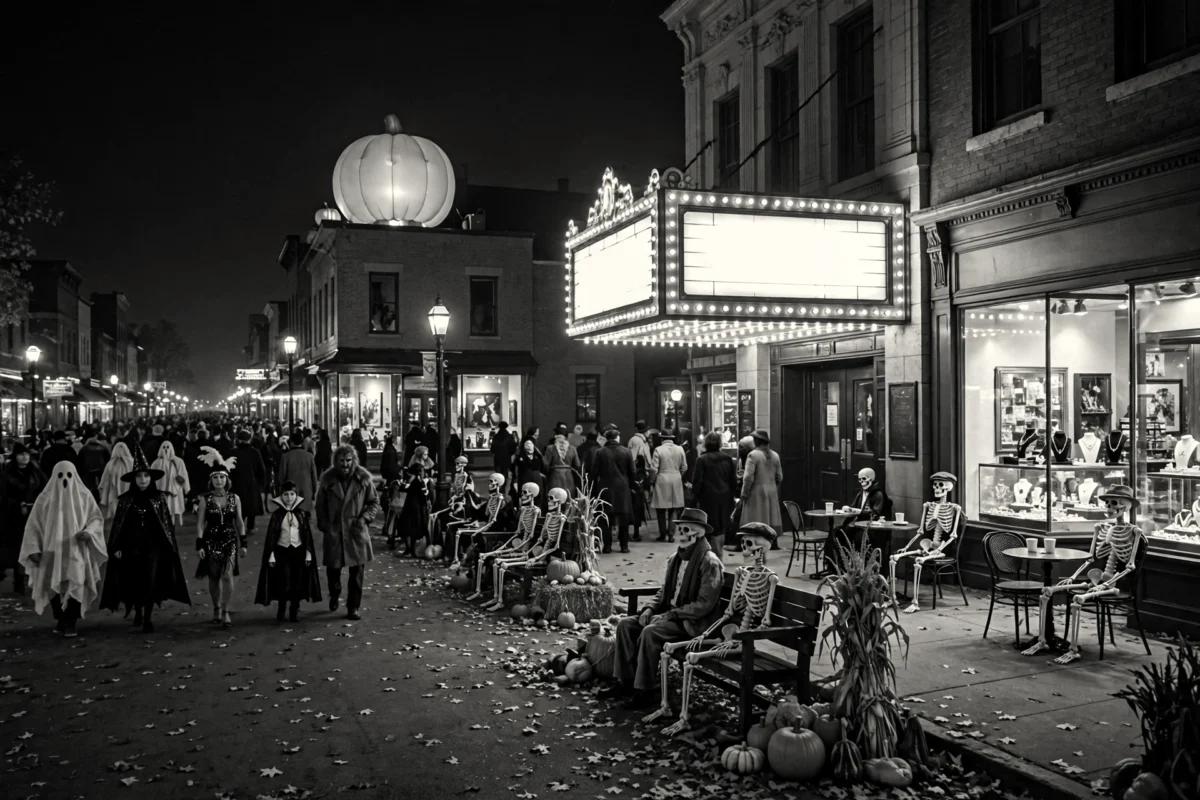
On Halloween night the whole of Northville came out into Main Street to goof off. Goofing off is the official term for several thousand adults in costume supervising several thousand smaller people in costume, while everyone pretends it is for the children.
Most of the rest of the population was skeletons. Northville does Halloween the way other towns do Christmas: more than two hundred life-size skeletons posed around downtown all through October, in café chairs, one walking a skeleton dog. They are not decorations, whatever the council calls them. By the second week they are residents.
Dana and Marcus sat on a bench outside the old picture house, sharing fries out of a paper boat. A skeleton in a Lions jersey shared the bench, enjoying everything enormously.
Marcus had been engaged to her for three years, which in Detroit counts as steady and in Britain would count as a short reign. The wedding was next year. It had been next year for a while. Next year was in no hurry at all.
“Next year,” Marcus said. He could read her mind; three years of practice. “It’s going to be lovely.”
“It had better be,” said Dana. “It’s had plenty of time to prepare.”
A tall man with a camera was working his way through the crowd: Amaan, six foot two of noise and shoulders, photographing everybody in sight. He backed up to the bench, framed Dana and Marcus without asking, and took the picture. Some men ask. Amaan arranged.
“Engaged?” he said, and showed them the screen. It was, annoyingly, the best photograph anyone had ever taken of them.
“Three years,” said Marcus.
“Then you’re not engaged,” said Amaan, with the confidence of a man who has got hold of a microphone at a wedding. “You’re established.” He sent the photo to Dana’s phone, took a fry as payment in full, and melted back into the crowd. He was Marcus’s friend: years old, deep in gym-and-camera history, and somehow never in the same room as the rest of Marcus’s life. Separate rooms, all of them well built.
Past the cider line, a girl of about five in a witch’s hat stopped dead in front of the picture house and stared up at the tall red-haired man who was locking its side door, a bowl of candy under one arm.
“Mom,” she said, in the tone of a small bomb disposal expert. “That’s… that’s him.”
“That,” said her mother, not breaking stride, “is Mr. Speid. He runs the theater. Say thank you for the candy.”
“Thank you for the candy,” said the witch.
“You are very welcome,” said Tom Speid, gravely, and put two in her bag.
The most recognized face on the planet spent the evening holding the door of a Northville cinema for a goblin, a fairy and three Spider-Men, and the town’s only comment had been about the candy. Northville had twenty years of practice at not making a fuss. The most famous man alive chose us. This is the rent.
He locked up and walked home through his Halloween like a rumor decided to be a neighbor instead.
Down Main Street, past the Center Street crossing, a red light glowed over a pair of velvet ropes. NOMI. Part restaurant, part listening room, the kind of door you have to be told about. Dana looked at it the way you look at a word on the tip of your tongue.
“One day,” she said, “somebody should make a list of all the doors in this town that don’t look like doors.”
“Somebody probably has,” said Marcus. “Somebody in this town has made a list of everything.”
He was right. Neither of them knew it yet. And tonight was not for going through doors anyway, because at the far end of the evening a different kind of door was opening. The kind with a dress code.
I walked in to work that night the way I usually do when the weather allows, and the streets around the Temple were already doing Halloween at full volume: witches, devils, three distinct schools of vampire, all of us drifting the same way, toward the masquerade, laughing the laugh of people who have paid good money to be frightened.
Two streets short of the Temple there is an alley I have passed a thousand times without it once asking for my attention. That night it made a sound.
Not a scream. Nothing so organized. A sack-of-oranges sound, meat and breath, and after it a quieter sound, which was a man finishing going down a wall.
I stopped at the mouth of the alley. I had not decided to stop. My feet are union men: at the first sign of trouble they down tools and wait for instructions.
Antonio was in the alley.
I knew him socially, the way I know everyone in this story: across a bar, in pieces, at his best. Letti Zebisco’s husband. The most charming man in Michigan, by acclaim of every room I had ever watched him enter. He was not in costume. He was in shirtsleeves, his cuffs rolled to the elbow in two exact folds, and his jacket lay folded over a crate against the wall, neat as laundry, out of the weather of what he was doing.
The man he had been doing it to was at the bottom of the wall, where the quieter sound had left him.
His face had been rearranged by somebody who knew the furniture. One eye was already a memory. He was breathing in the shallow, expensive way, each breath negotiated separately, and both his hands were up in front of him in the posture men keep for weather: not defense, not anymore. Surrender, with the paperwork still to come.
Antonio stood over him the way a man stands over a finished job. Then, without hurry, and entirely without temper, he put in one more. A short one. Considered. The way you turn off a tap.
That was the worst of it, and I have had the whole winter to check the finding. Temper I could have filed under weather. Men lose it. It rains on everyone, and it passes. This was not temper. This was administration.
At the mouth of the alley, a party went past on its way to be frightened by professionals: a vampire, two witches, a man dressed as his own tombstone. The tombstone glanced in, took in a gentleman standing over a gentleman, and read the whole thing as theater. “Commitment,” he said, approving, and the witches laughed, and the night carried them on. It was Halloween. The city had dressed itself as monsters. Nobody audits a monster on Halloween.
Antonio rolled his sleeves down. He did the cuffs first, one button each, unhurried, dressing for dinner in a room without a mirror. He lifted the jacket off the crate, shook it out once, the way you shake a flag, put it on, settled it, settled his collar, and did his breathing, and by the end of it he was the evening again: the best-dressed man on the street, which on Halloween in Detroit is not a high fence, but he cleared it without touching it.
Then he turned toward the mouth of the alley, toward the streetlight, and toward me.
He saw me.
There was no startle in it, which is the part I remember at cost. He finished settling his collar under my eyes, the way a man finishes a sentence, and what passed between us was professional: an assessment, and the small acknowledgment that it was mutual.
I stepped aside. Not in fear; I have examined it, and it was manners. He came past me at a gentleman’s pace, the crowd took him the way a river takes a leaf, and inside a minute he was a man in a coat going to a party.
Whatever had happened in that alley had two keepers now, before Door One, before the books, before the year introduced itself.
By eleven, half of Northville seemed to have followed the night into Detroit, to the Masonic Temple on Temple Street, the largest Masonic temple in the world, where Theatre Bizarre, the city’s great masquerade, takes the place over for its late-October run. Eight floors of it: circus, burlesque, sideshow, bands. And one rule, printed plainly and enforced without appeal:
No costume, no entry.
The only door in the city that turns you away for being yourself.
The masquerade itself had begun as an unlicensed party the city shut down, and survived by finding a temple: the biography of a blind pig, the manners of an opera house.
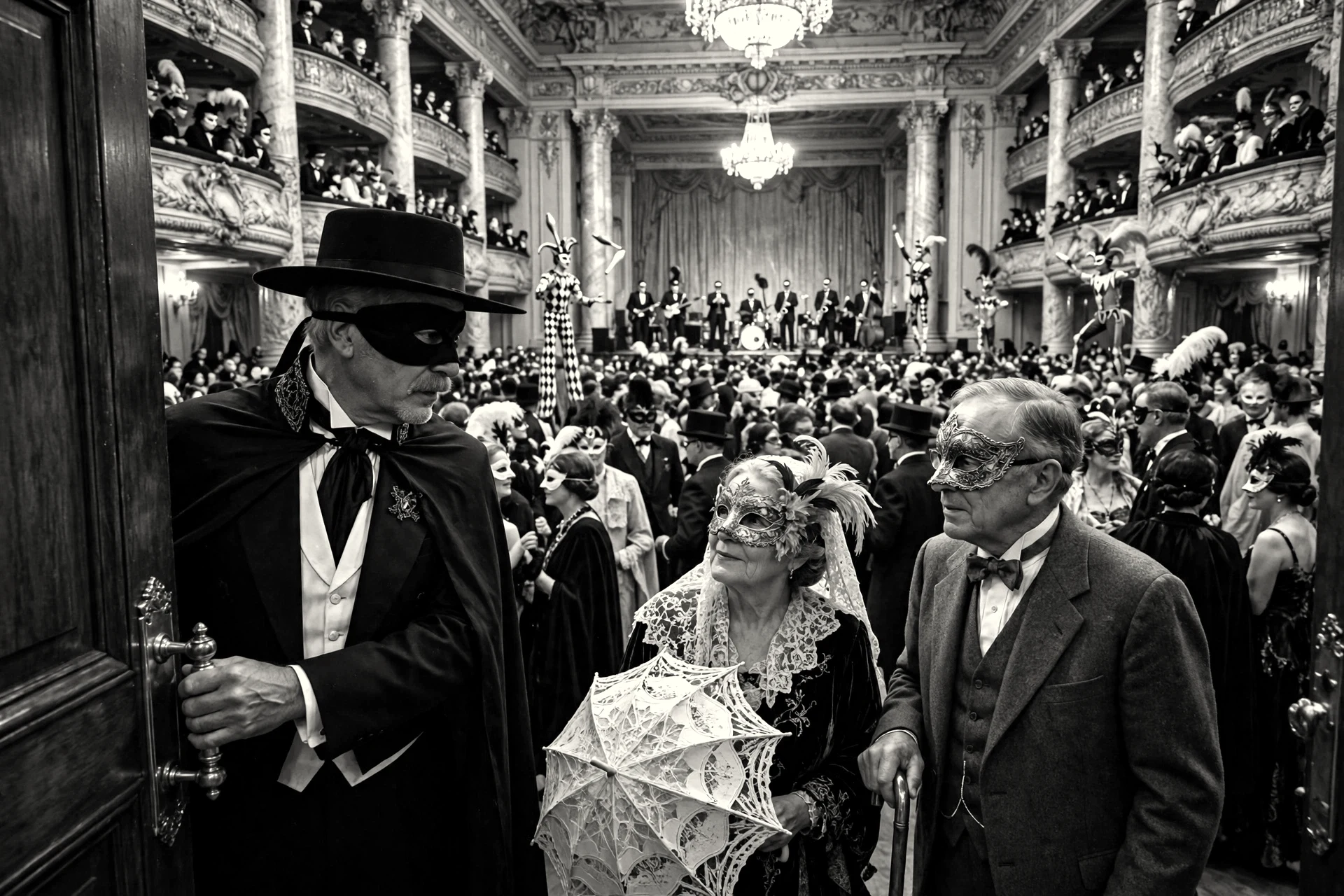
Inside, the households of this story passed each other all night, masked, and knew nothing about it.
Dana and Marcus danced badly and happily in a second-floor ballroom. I was working that bar. I poured Dana a rye and made Marcus’s the way Marcus took it: one rock, no garnish. Dana didn’t notice. Nobody ever notices the bartender. That is rather the design of the bartender.
They moved me up to the fifth floor for the rush. In a room lit like the inside of a jewel, I poured Amaan his Laphroaig. Wherever Amaan was, that was the party. He was dressed as something between a maharaja and a road accident, and he was the most alive man in the building.
It was the one night of the year when the whole world had agreed to his terms. Everybody was hiding. Hiding was the dress code. A man could be exactly as loud as his heartbreak needed him to be.
At a service door on the ground floor, a man in a Zorro mask held it open, gallant as a matador, for an elderly lady in a witch’s hat and her husband, who were having words with a staircase.
“Madam,” he said, “allow me. The stairs in this building were designed by a man who hated joy.”
“You,” said Rose, taking the door and the gallantry in one motion, “are a dangerous man.”
“I was,” he said, with enormous satisfaction. “Now I am a door with opinions.”
He did not know her. She did not know him. Eddie, arriving with the coats, thanked him like a neighbor, which is what he was about to become.
He left at eleven, before midnight could make claims on him, and went out through the crowd his daughter was still conquering two floors up.
“A man should leave a party,” he said to nobody in particular, “while it is still improving.”
Then he went home to bed, and Halloween closed its doors behind him.
II. Thanksgiving
Thanksgiving came, as it does, to four separate houses, where four stories sat down to dinner each believing it was the only story. Most of them were not even acquainted. The year had not started yet. This was the before picture, and like most before pictures, everyone in it is smiling slightly wrong.
I was at none of those tables. I heard about all four later, in pieces, across my bars, and I have put them together the way you put together any regular: in the order it was confided.
At Dana’s parents’ house, the table ran the gauntlet in its home kit.
“Three years engaged,” said an aunt, passing the gravy like a verdict, “is not an engagement. It’s a tenancy.”
“So,” she said. “A date, Marcus. You must have a favorite month by now. You’ve had three years to shop.”
“Spring,” said Marcus, carving, beautifully. “Spring is very strong. Dana likes spring.”
“You were fond of spring last spring,” said the aunt. “I have the fondness in writing.”
Marcus agreed with the aunt, with Dana, and with an uncle who held the opposite position on spring, stuffing and the Lions, and carved on, perfect for everyone and decisive for no one. Dana watched him and loved him, and put the loving and the watching in two different drawers of the same chest. That was where she kept them all year.
At Letti’s father’s house, Letti ran the meal like an operation she expected to be decorated for. Courses timed. Wine correct. Her father’s stories brought out at exactly the moments the table needed lifting, which was often. He told the one about the door in the desert, which nobody believed and everybody requested. Pouring the coffee, his hand shook a little. Nobody mentioned it. Letti filed it under cold.
At nine, Antonio stepped out onto the porch to take a call. Work. He was gone eleven minutes. He laughed once, at something the porch heard and the house didn’t.
“He’s brokering peace between two forklifts,” said Letti, topping up glasses without missing a beat or a glass. “The forklifts are winning.”
Only her father saw the covering happen. He saw it the way you see a card palmed, with professional appreciation, and a look that lasted one second too long. He said nothing. He topped up her coffee instead, gently. One professional to another.
At Amaan’s sister’s house, there was a place set for Yasmine.
She had a headache. She would want him to go; the family expected him; photographs would be taken. All of it arrived in a message of four lines, about the length at which the marriage did most of its business.
“You set the place,” said his sister, watching him lay the fork straight.
“I set the place,” said Amaan. “That is what the place is for.”
Then the neighbor, kind and beaming, produced his triumph: a halal turkey, specially ordered, for Amaan.
Amaan is a Punjabi. He is also a Hindu. People had been getting that wrong in both directions for forty-one years, usually at volume, and almost always, as now, out of love. He ate two helpings. He asked for the name of the butcher. He praised the bird in terms that left the neighbor glowing for a week.
It was the second kindest misunderstanding of his year. The first was that everyone at the table believed he was fine.
At Rose and Eddie’s, the strays got fed: neighbors, a student whose family was three time zones away, a widower from the next block “just passing” with a pie. Paper napkins, a table extended so many times it had opinions, and wine of a quality that sat on it like a Rolls-Royce in a supermarket parking lot: unexplained, unremarked, and definitely not on offer.
“This was on offer,” said Rose, a lie so transparent it deserved framing.
After the pie, Rose read aloud from her phone an article a local company had published. A map, of all things, of the city’s hidden bars. Thirty-two of them.
Every unmarked door, every room behind a bookcase, every basement that had outlived its century, listed and verified and mapped. And there was a challenge attached. A year to do them all. A little notebook. Signatures. A ring mark pressed in whiskey, like a seal on a treaty.
“Listen to this,” said Rose. “Thirty-two doors, and every one of them hiding in plain sight. There’s always a notebook involved with the good ones.”
“You’re going to make us do it,” said Eddie. He had been married to her for forty-three years and could hear a decision being loaded.
“I’m going to make us do New Year properly this year,” said Rose. “The young ones from two doors down. Here. Dishes in the sink and the radio on. Like the old days, except with better wine, which,” she raised a finger, “was on offer.”
And in four separate houses the seeds of the year went in so quietly nobody heard them land. An invitation offered across a fence’s worth of familiarity. An article filed away in a daughter’s head under New Year, at a table where a phone call had just been covered for. A place set, and straightened, for a woman who wasn’t coming. And a notebook. Although nobody, yet, had bought a single notebook.
The radio would do the rest.
III. New Year’s Eve
On the last day of the year, a stationer’s shop in Royal Oak sold rather more small pocket notebooks than it would expect to. The first buyer, at lunchtime, was a lady in her seventies who knew what she wanted: four, identical, and no nonsense about the covers. She paid in a way that suggested the price of notebooks had not been consulted.
The second, at four o’clock, was a stunning woman in a hurry. She bought three, and a pen, and made the assistant test the pen.
The third purchase had happened the day before. The assistant remembered it anyway, because the entire transaction had consisted of two words:
“One?”
“One.”
All day, on every radio in the city, the joke ran. A local company had published the map and the challenge (one year, thirty-two hidden doors), the morning show had adopted it as its bit, and the bit had got out of the studio.
In a corner, a television carried, muted, the other story of the year: a Michigan senator, a doctor with a famous smile, running for the whole country against a man who campaigned like a fire in a theater. And that night, in three separate rooms, people made the same resolution off the same broadcast, for completely different reasons.
The company is called Deadly Company, which has caused a certain amount of confusion in this city for years, because the name was already taken.
In the first room, Rose and Eddie’s front room, paper crowns, the neighbors in, Marcus made the speech of his life, because she had looked at him over the dishes and said, quite gently, “Go on, then.”
“I am,” said Marcus, standing in a paper crown, “a man with an excellent record of nearly. Nearly finished the…” “So. Thirty-two doors. One year. I would like…” He looked at Dana, and the room went the kind of quiet rooms go for other people’s weather.
“I would like to be a person who finishes something that takes a year. Starting with this. Finishing with…” He stopped. He smiled. It was, everyone agreed later, the most Marcus sentence ever left unfinished. “Starting with this.”
“Seconded,” said Eddie, raising the wine that was not on offer, “by a man of eighty-one, in slippers.”
The television in the corner was still running the other argument, muted.
“Charm,” said Marcus, to the screen. He was recovering himself the way he always did, on ground he knew. “That’s how you beat a bully. You out-charm him. You make the whole country want to sit at your table.”
“You name a bully,” said Eddie, mildly, “in the room where he lives, or he grows.” He shrugged, apologetic at his own treason. “Forty years of marriage to a woman who wins arguments in shops. You learn where bullies live.”
Four notebooks were signed, and the rules were followed to the letter, because Rose had read them twice.
Across the city, in Letti and Antonio’s apartment, Letti read the challenge page aloud like a constitution being ratified.
“The entry records the date and the time,” she read, “and what you drank. It is signed by the bartender or the server. Then you dip your finger in the whiskey, wet the bottom of the glass, and press the ring onto the page. What it leaves is a coaster ring print from a wet glass.” She looked up. “A photograph proves you were there. The book is the year. And the memories go in the book too. Whatever else the night gave you.”
“And if the bar has a stamp?” said her father.
“If the establishment has a stamp of its own, we collect it on the same page. As a gift,” said Letti, firmly. “Not a rule.”
“You,” said her father, “were wasted in civilian life.”
She handed out the notebooks like commissions. Antonio took his with both hands, and at midnight he pressed his ring with the flourish of a man signing a peace treaty: beautifully, perfectly, the way he did everything you could watch. At ten to twelve he had stepped out onto the balcony for a call.
Work. Eleven minutes. He came back in with the cold on his coat and kissed his wife’s temple, and nobody said a word. But her father, refilling her glass, gave her the same one-second-too-long look he had given her at Thanksgiving, and Letti, for exactly one second, let him see that she had seen it too.
Then her father signed the first page of his own book, in a hand that shook a little and disguised it, characteristically, as flourish. And under his name, on the first page of hers, he wrote four words in the same magnificent scrawl:
Excitement and adventure await.
In the third room, there was nobody.
Amaan’s apartment was tidy the way a held breath is tidy. On the kitchen counter sat a radio, a glass, and a small notebook still in its paper bag from the stationer’s. Yasmine was at her family’s. This had been explained in a message of four lines. He had read it the way engineers read stress reports, looking for the number that mattered, and he had replied: Of course. Give them my love. Happy New Year, jaan.
He had sent it at nine o’clock. It had been read at 11:15. He knew because phones tell you that now. Phones tell you everything now except the thing you need to know.
At twenty to midnight he took the notebook out of its bag, put on his coat, and walked to the corner bar, which was doing the quiet kind of New Year’s Eve trade. Behind the bar was me.
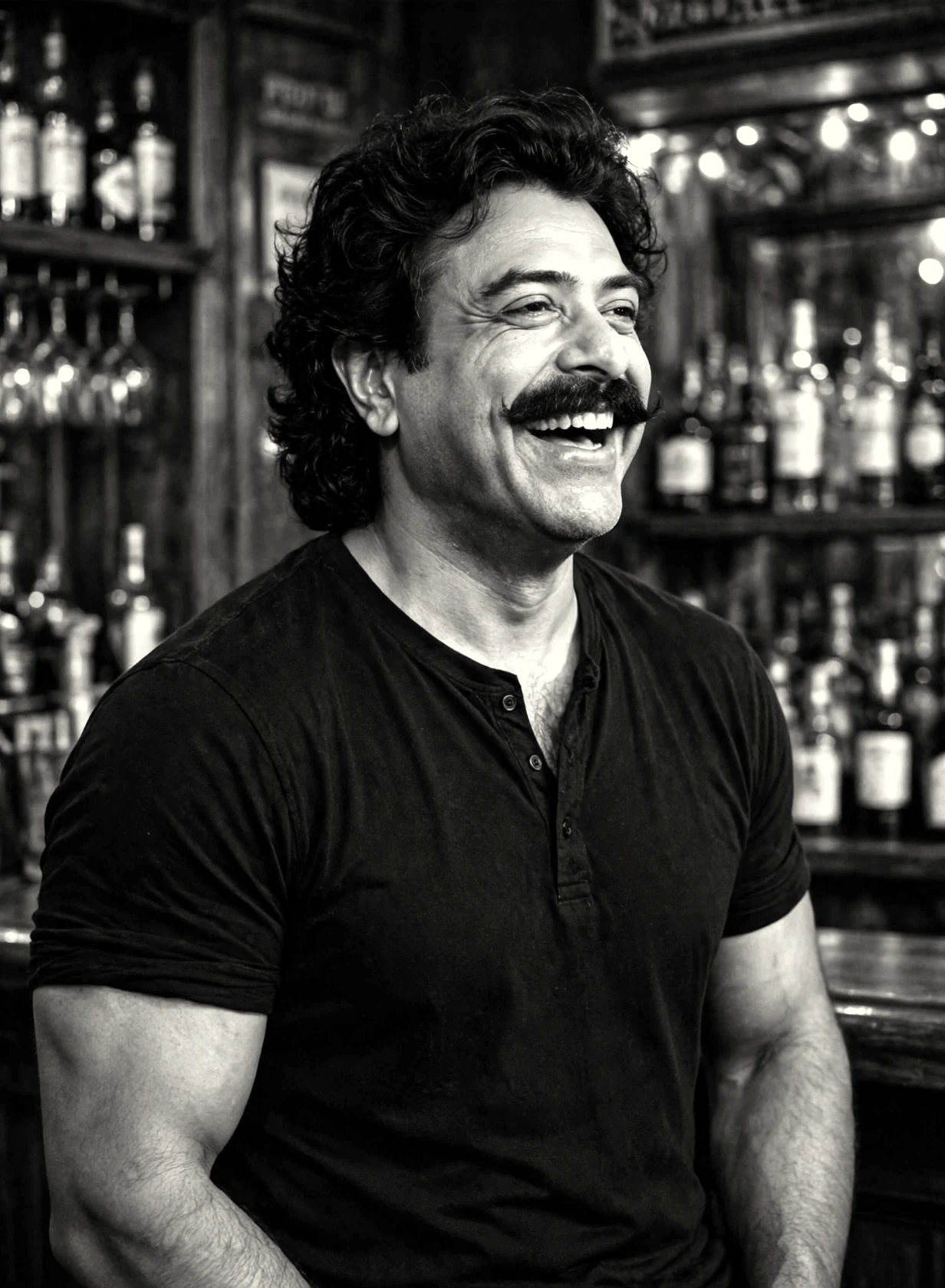
I had poured for Amaan in three bars across nine years. I had watched the loud years and this year, which had no name yet. And I did what I have always done, which is my whole profession in one gesture: I set down a Laphroaig, one cube, and asked no questions at all.
“You’ll sign something for me,” said Amaan. And he explained: the book, the rules, the first page. He explained it at length, the way a man fills a silence so it cannot fill itself.
I read the page. I signed the page, in a bartender’s signature, practiced and plain: the first name in his book. I wrote the date and the time in beside it, because the rules were the rules.

“You’re the first person I’ve told,” said Amaan, “about the book.”
I went back to my glasses. It was a secret, then. With a witness.

At midnight the radio counted down and the people in the bar raised whatever they were holding, and Amaan dipped his finger in the Laphroaig, wet the bottom of the glass, and pressed the ring beside my name. Alone at the bar, in the last hour of the old year. His phone lit up beside the glass at two minutes past twelve.
Happy new year
Three words. No punctuation. She had never once, in four years, used punctuation when she meant it least. He looked at it for a long moment. Then he did the thing he had been doing all year, at full size, in public and in private.
He smiled, a big, real-looking smile, the best work of his year, and typed back Happy New Year, jaan, and put the phone face down, and finished his drink like a man celebrating. I was the only audience, and I did him the courtesy of carefully not watching. That is the second professional skill.
After close, I washed the glasses. I knew something about every person who had signed a notebook that night in that city. I also knew a name I keep in a separate drawer from all the others: the most famous name in the world, a man I once poured for in the last hour of a Tuesday.
I would no more repeat that name than I would repeat anything of Amaan’s. I could not have connected these people if I had wanted to. I did not want to. I just kept pouring, exactly where each of them happened to be.
In the first room, the night was ending in coats and leftovers when Dana’s phone lit up. On the screen: her oldest friend, in the other country, a nurse between shifts, laughing in a hospital corridor with a paper crown of her own.
“You’re actually doing it?” she said, delighted. “The doors thing? Dana. That is the most romantic suicide pact I have ever heard. Count me in for August. I want Windsor. I demand Windsor.”
Dana looked at the woman on the screen and thought, you have no idea what you are walking into. What she said was, “Windsor’s yours.”
In three rooms across the city, eight notebooks had been signed, and ringed, and shut. Nobody in any of those rooms knew what the other rooms had done. Only the radio knew. And me, in my way. And now you.
It had begun, the way all the best years do, as a joke nobody could take back.
Door One was waiting.
Endnote (real doors, for the Journal): Theatre Bizarre, the masquerade at Detroit’s Masonic Temple, held across late-October nights; costume is required. NOMI, 133 W Main St, Northville: follow the beat to the red light and the velvet ropes. Both are in the map: deadlycompany.co/detroit-speakeasy-scene/ …and the challenge is open to every reader: deadlycompany.co/one-year-of-hidden-bars-and-speakeasies-tour/