 CompanyMade in Detroit | Est. 2026
34 Doors
Episode 1: The Shelby
The Shelby is not one of my bars.
I should say that plainly, because a bartender’s credit is his accuracy. I did not pour a drop of what follows. I know Door One the way I know most doors I have not worked: by what people carried back from it, in pieces, on other nights, to mine.
Dana told me the beginning, laughing at her own foresight. Amaan told me almost nothing, which, from Amaan, was a detailed report. Marcus told me the middle by accident, the way men confess to a bar: sideways, while looking at the glasses.
Put together, it goes like this.
Door One nearly did not happen, which would have been very Marcus.
It was the first Friday of January, Detroit cold, the kind of cold that makes a persuasive argument for any plan involving a sofa. Marcus made the argument anyway. He made it well. He had slides, practically: the weather, the week he had had, the entirely reasonable position that a year is long and contains many Fridays, several of them warmer.
“You gave a speech,” Dana reminded him, holding up her phone. At New Year she had recorded exactly eleven seconds of it, the good part, him in a paper crown telling a room of near-strangers that he intended to be a person who finishes something that takes a year. “I keep it for emergencies. This is an emergency.”
So they went. And if Marcus dragged his feet slightly on the walk from the car, he would like it noted that a man can be dragged ceremonially. It still counts as arriving.
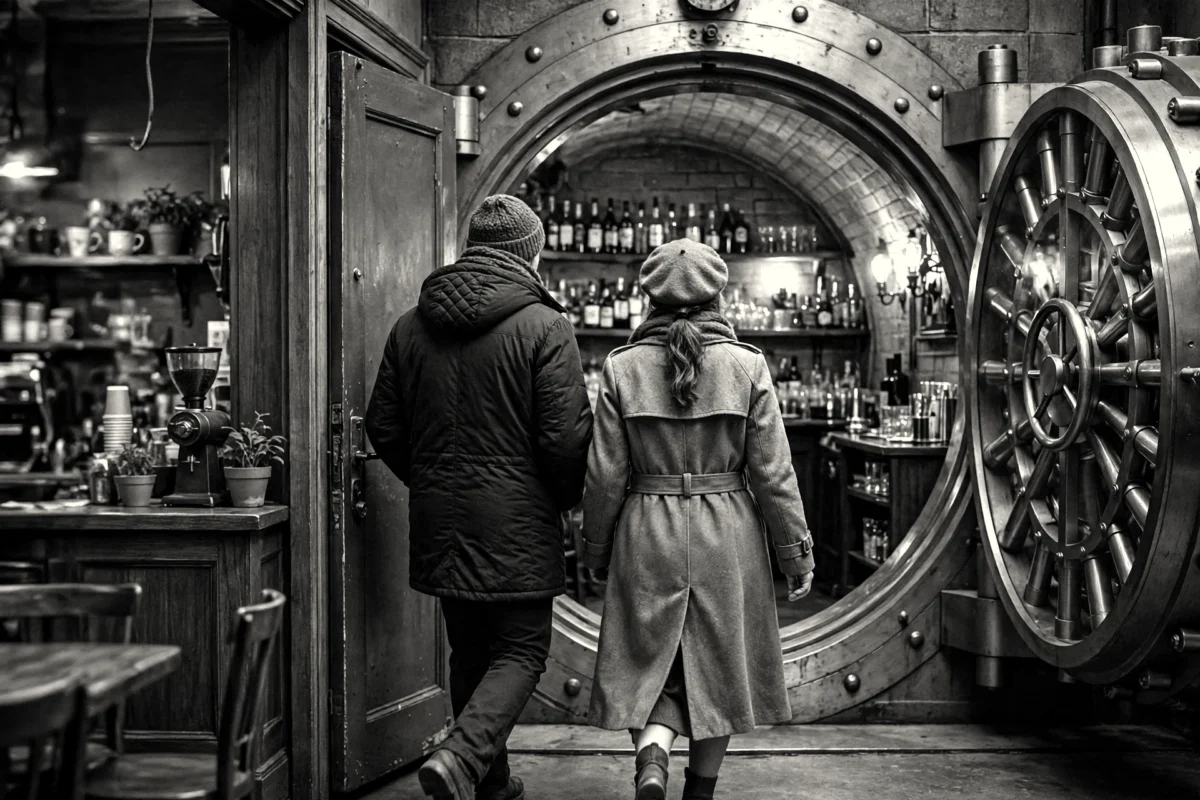
The Shelby does not have a door, in the usual sense. It has a rumor. There is no sign on Shelby Street, nothing at 607 to tell you a bar lives there, because the bar lives underneath a coffee shop, at the back, down the stairs, through a discreet blue door.
You go into Coffee Down Under, past the people working on laptops and the people pretending to work on laptops, and you keep walking, with the particular confidence of a person who has been told, and at the back you go down, and the city changes key.
“Tell the host you’re here to see Shelby,” Dana murmured, reading off her phone. She had the article saved. Of course she had the article saved.
“I feel like we’re collecting a package,” said Marcus.
“We are,” said Dana. “It’s us. We’re the package.”
The blue door opened into a bank vault.
Not a room decorated as a vault. A vault: a restored 1920s bank vault, the real article, all that steel and weight, in the basement of the Financial District, with a bar inside it and the lights low and a hum of people who all looked like they had been let in on something. Which, to be fair, they had. Marcus stood in the doorway of it a second longer than a man needs to stand in a doorway.
“Okay,” he admitted. “That’s a door.”
They took two seats at the bar and ordered the thing the place is known for, the Shelby Signature: Astral Blanco, lime, agave, manzanilla sherry. It arrived pale and cold and entirely serious, the kind of drink that makes you sit up straighter.
Dana took a photograph of the two glasses in front of the vault door, because some photographs are just evidence and some are the start of a collection, and then she got out the notebooks.
Two of them. Hers and his, from the set of four Rose had produced on New Year’s Eve like a woman dealing cards.
“Date and time,” she said. “What we drank. Then she signs it.” She nodded at the bartender. “Then the ring.”
“You’re enjoying the rules,” said Marcus.
“I am a woman of hidden depths, and all of them are administrative.”
At the far end of the bar, a man was laughing at something the bartender had said, in the way of a man for whom laughing is a public service. Six foot two. Shoulders. A glass in front of him, two fingers of something over one cube, smelling faintly of a bonfire at the seaside.
Marcus looked. Looked again.
Amaan lives in an apartment that was decorated by a committee of two, one of whom has stopped attending the meetings. There are two of most things in it, the way there are two of most things in a marriage.
That night, in the hour before the Shelby, he came in from a job with his cameras and set two glasses by the sink out of the pure choreography of a man who has poured for two for years, and stood looking at them, and put one back in the cupboard with the care of a man defusing something he had built himself.
Then he showered, and dressed, and went down to a vault door in the Financial District to meet his friends, and if you had seen him arrive you would have sworn the evening had been designed around him. It had not. He had designed himself around it. There is a difference, and the difference is most of what I know about Amaan.
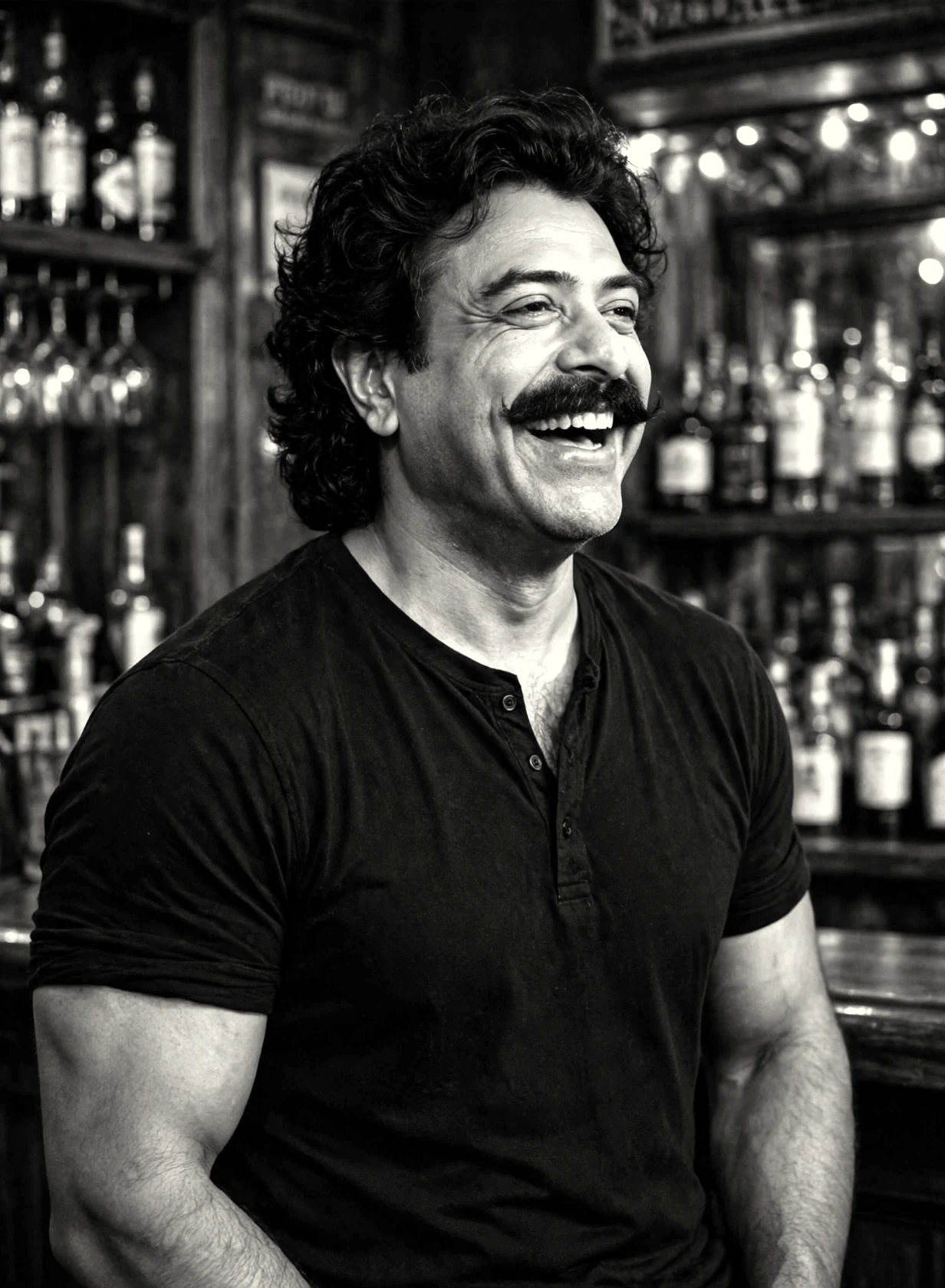
“Oh no,” he said, happily. “Dana. This is Amaan.”
Amaan was Marcus’s friend. Years of it, the gym-and-cameras kind, and somehow, in all those years, he had never once been in the same room as Dana, who had heard the stories the way you hear about weather in another state. He came down the bar at the speed of weather arriving.
“The bench couple,” he announced. “The fries. Halloween. I took your photograph and it was the best photograph anyone has ever taken of you, and you’re welcome.” He shook Dana’s hand like she was a visiting dignitary. “You’re real. He talks about you like a rumor with good hair.”
“You’re the photograph,” said Dana. “He showed it to everyone at Thanksgiving. It got more compliments than the turkey.”
“I am a public utility,” said Amaan. He turned his glass slightly, so the light caught it. “Door One, then. You too. The whole city is doing this thing. There’s a couple by the vault with a notebook fatter than mine, and theirs has already got a stamp in it. A stamp. From somewhere. I have stamp envy and it’s only January.”
Marcus cleared his throat the way a man clears a runway. This was his door, his pact, his year of finishing, and the evening had a shape in his head that he had been carrying since the paper crown. “Right,” he said. “Door One. First page of the book. We should mark it.”
He raised his glass toward the two of them, and toward the occasion generally, and got as far as “To…” when Amaan, on his way past with his glass to greet the bartender by her first name, said something to her in an undertone, and she laughed, and the laugh went down the bar like a line of dominoes, and two men at the vault’s far end turned in their seats to see what the evening was about.
The evening, plainly, was about Amaan.
“To the man who has been in this room four minutes,” said Dana, raising her glass to the one still raised in her fiancé’s hand, “and is already its mayor.”
“I accept the office,” said Amaan, arriving back with the bartender’s regards and somebody else’s stool story. “It carries no duties. It is my favorite kind of office.”
Marcus drank to it. He was gracious about it. He is always gracious about it, which is most of the technology of nearly.
“What are you drinking?” said Marcus. “It smells like a shipwreck.”
“Laphroaig,” said Amaan, with reverence. “One finger for me, and another for the pasoori. That is the order, anywhere on earth. Peat. Smoke. Seaweed. A distillery apologizing for nothing. Places that know what they’re doing stock it, and this place knows what it’s doing.” He raised it to them both. “To finishing things.”
Marcus lifted his glass a beat too late for it to be casual. “To finishing things.”
“And Yasmine?” said Dana. “Working,” said Amaan, “or else reorganizing a drawer to punish it. We have a rule at home. She cooks when the moon is full, and I cook when it isn’t, which is how a man gets to know every delivery driver in Detroit by his first name.” He said we the way a man reads a sign that has not changed yet. Nobody at the table heard it as anything except a joke, which is what it was, in January.
The bartender signed their pages without being asked twice; she had clearly done it before, possibly that week. Date, time, the Signature, her name in a quick hand. Dana pressed her ring first: finger dipped, the bottom of the glass wetted, the mark set down on the page beside the writing, clean as a seal on a treaty: a coaster ring print from a wet glass. Then Marcus.
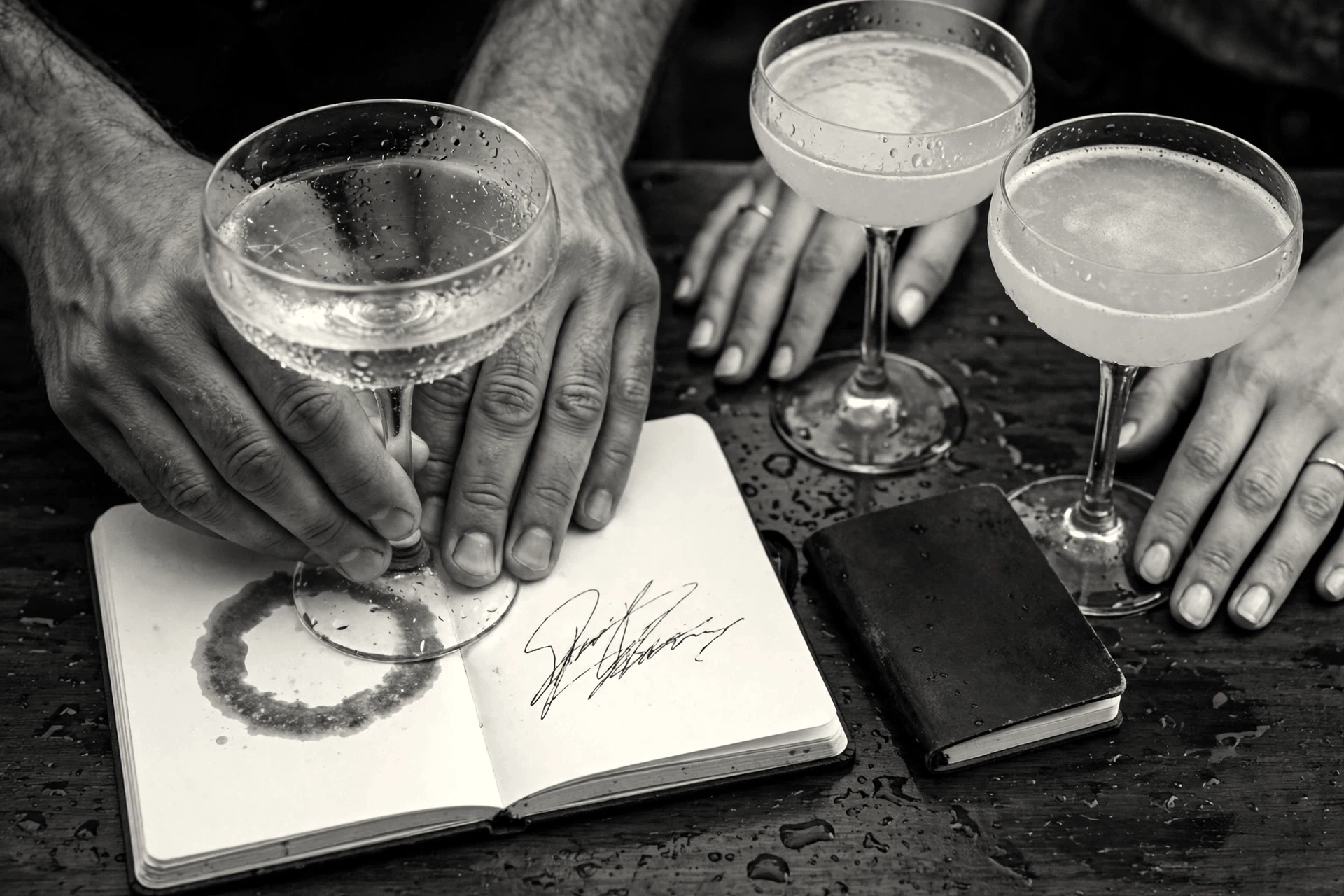
He did it slowly. That is the whole report. A man with an excellent record of nearly, in a bank vault under a coffee shop, on the first Friday of the coldest month, wetted the bottom of his glass with care and pressed his ring onto the first page of his book and held it there a second, making sure.
“There,” he said, a little surprised. “Door One.”
Under the entry, in her own book, Dana wrote the thing the night had given her, because the rules said the book takes those too. She wrote: He came. In January. Voluntarily.
Amaan’s phone was on the bar. He took a photograph of the blue door on his way back from the restroom, the way a man collects a view, and sent it to Yasmine with two words: Door One. He turned the phone face down and went back to being the loudest, warmest thing in the vault, and if the bartender noticed that he checked the phone twice more before his glass was empty, she had the professional grace to pour without comment.
Some rooms know. A vault, of all rooms, knows how to keep what’s put in it.
Dana’s phone lit up while they were getting their coats. A message from Letti: a photograph of three notebooks fanned on a bar top, three rings pressed, three signatures, and underneath, in Letti’s hand: Door One. Done properly. And then, a second message, apparently unrelated: Dad was magnificent. Antonio had a call.
“Your friend did hers too,” said Dana, showing Marcus, pleased, the way you are pleased when a plan turns out to be a net and it catches people. “Same night.”
“Mm,” said Marcus, looking at the coats, the cold, the door. “Same night.”
Outside, Shelby Street was empty and shining with frost. Amaan drove home alone through the quiet city with the radio on, laughing a little at the host, who was asking the Door People of Detroit to call in and report. At a red light on Jefferson the laugh ran out, the way a song runs out, and he sat for a moment in the sudden quiet of the car, a man in the front seat of his own life, looking at nothing in particular.
Then the light changed, and he drove on.
Amaan never told me about the red light. He did not have to. Some stories arrive as facts, and some arrive as weather, and a man who has poured for Amaan for nine years has learned to read both.
Door One was done. Thirty-one to go. The message he had sent her from the vault, two words long, was still waiting for its answer.
Endnote (real door, for the Journal): The Shelby, 607 Shelby St (basement), Financial District, Detroit. There is no sign: go into Coffee Down Under, head to the back, downstairs, through the discreet blue door into the restored 1920s bank vault, and tell the host you’re here to see Shelby. Reservations via OpenTable are recommended; walk-ins are welcomed. 18+. The Shelby Signature is Astral Blanco, lime, agave and manzanilla sherry, and the bar was a 2022 James Beard semifinalist for Outstanding Bar Program. Open Wednesday and Thursday 5pm to midnight, Friday and Saturday 5pm to 1am. The door is on the map: deadlycompany.co/detroit-speakeasy-scene/ and the challenge is open to every reader: deadlycompany.co/one-year-of-hidden-bars-and-speakeasies-tour/