 CompanyMade in Detroit | Est. 2026
34 Doors
Episode 3: The Skip
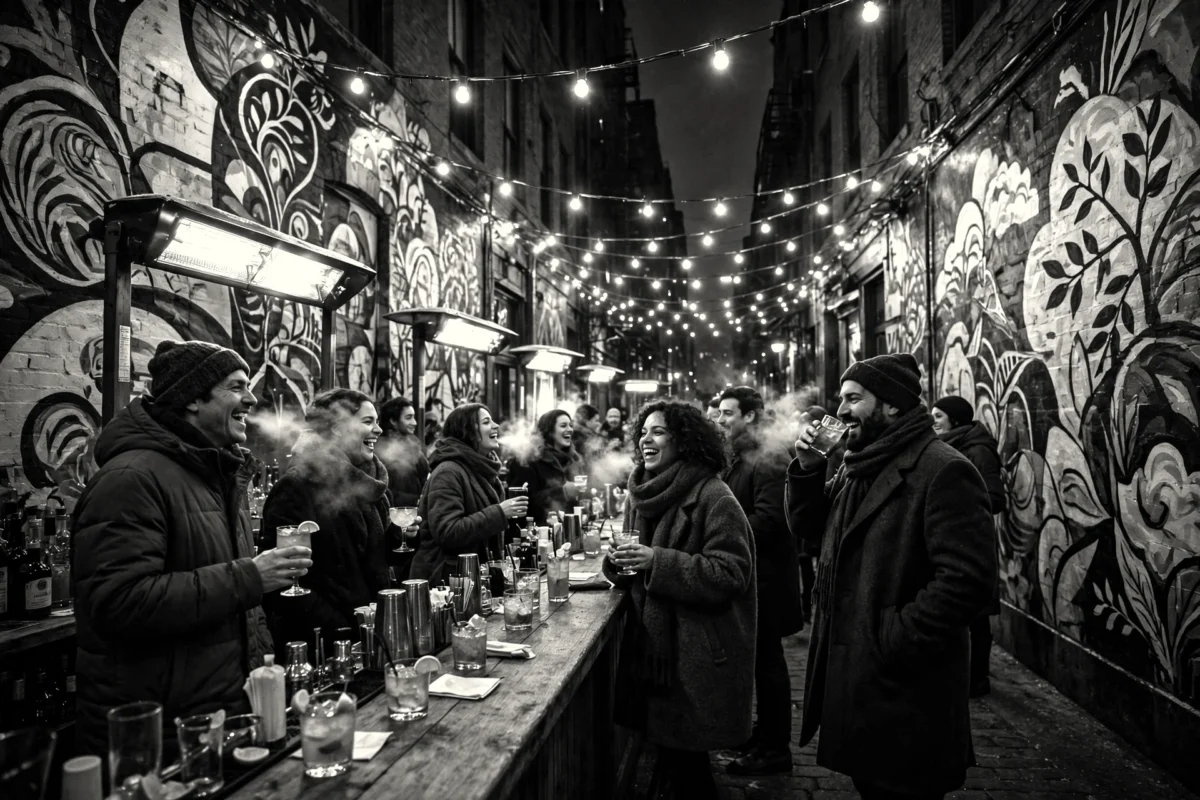
Door Three has no door. I feel this should be said early, because the Door People were as surprised as you are.
The Skip is an open-air bar standing in the middle of the Belt, the mural-covered alley off Library Street, and the trick of it is not finding a door. The trick is finding the alley. Nothing of it shows from the street. You walk in, in January, in Detroit, and you drink outside, because the room is the weather and the weather, that Friday, was showing off.
Dana told me this one. Amaan told me this one twice, once about the argument and once about nothing. Marcus asked me a question about it that the bartender’s code does not permit me to answer, and we will come to that in its proper place. It was not about the argument.
Dana has a picture on her phone that she checks the way other people check the weather, to find out what the day expects of her. It is a dress, white in the way of a decision, the one she has had in mind since before the ring, saved from a life she keeps meaning to start on a date she keeps not saying.
She had looked at it that week, in the small hours, with the apartment quiet and Marcus asleep in the next room in the untroubled sleep of a man with nothing in any drawer. She looked at it for a while.
Then she put the phone face down, a gesture this story is going to get a great deal of use out of, and in the morning she texted the boys about an alley, and that was that, until it was not.
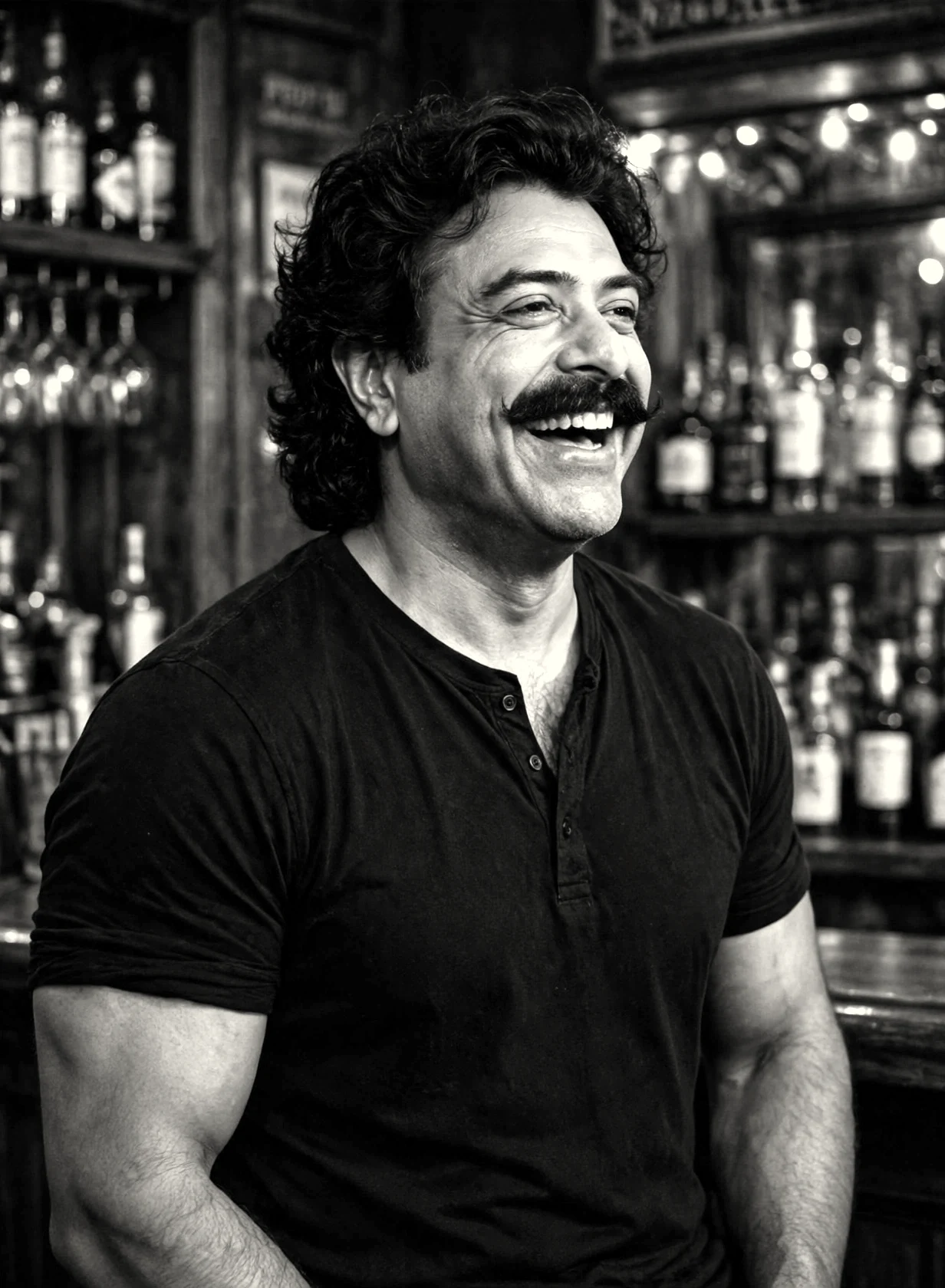
He was already there.
Amaan, at the bar, in a coat built for a taller winter, holding court with two strangers who were laughing the laugh of people who have just been adopted. Second door running, same man, same volume. The Skip keeps a bottle of Laphroaig for the serious, which Amaan took as a personal compliment from the establishment, and his double was already poured, one cube, exactly as ordered on earth.
“Third time,” he announced, as Dana and Marcus arrived. “Halloween, I photograph you. The Shelby, I toast you. Now the alley provides you. At some point, legally, this becomes a haunting.” He produced his phone with the air of a man laying down a winning hand. “Numbers. Both of you. A man cannot keep meeting his friends by accident. It is inefficient, and I am a professional.”
That is how a web becomes a thread: not in a speech, but in a phone changing hands over a bar. Names went in properly this time, with surnames, and Amaan named the group thread before either of them could stop him, and the name was terrible, and it stayed.
Then the books came out, because by Door Three the books come out the way other people’s holiday photographs come out, and there is no stopping it and no one wants to. Amaan inspected Marcus’s first page with the seriousness of a building inspector. “This ring,” he said. “Look at this ring. A man pressed this who intended to still be doing it in December.”
“I held it a second,” said Marcus, a little defensive. “Making sure.”
“That,” said Amaan, “is the entire religion, brother. The rest is commentary.” He showed his own first page, where his ring sat wide and confident and slightly theatrical, the signature under it already fading into legend, and Dana laughed and wrote nothing down, because some of it you just keep.
The drinks at the Skip are frozen, which in January is either a mistake or a philosophy. Dana and Marcus took the house’s famous frozen Irish coffees, because when a bar is known for a thing, you have the thing, even if the thing is slush and the month is January and your gloves are already off for the notebook. The heaters glowed.
The murals watched. Somewhere behind them the bartender signed their pages and they pressed their rings one after the other, the mark going down clean on the page: a coaster ring print from a wet glass. Door Three, done in the open air, in the cold, voluntarily. Marcus looked at his book like a man checking a score he does not entirely believe.
Then the television over the bar did what televisions over bars do, and put the world back in the room. A news segment: Senator Jamal Malik, the Michigan man with the impossible résumé, running at the presidency like a man who has read the course record, and across from him in the race the other fellow, the one whose rallies sound like a bar emptying. The sound was low. It did not matter. My two regulars did not need sound.
“He wins sweet,” said Marcus, with total certainty. “Watch. The other man wants a brawl in a parking lot. Malik smiles, Malik thanks him for the question, Malik goes home with everybody’s grandmother. Sweet wins. It is not close.”
“Gloves off,” said Amaan, with the certainty of a man correcting the weather. “Sweet gets you a beautiful concession speech, my friend. I have given that speech. In my own kitchen.” He caught himself half a beat late and covered it with volume, the way he covers everything. “The man across from him is not playing by house rules. You do not thank a fire for the question. You put it out.”
“Point to Amaan,” said Dana, from behind her frozen coffee. “He is ahead on grandmothers, Marcus. On grandmothers it is not close.”
“The grandmothers are exactly the country,” said Marcus. “You do not win a country by frightening the grandmothers. You win it by being the man they set a place for.”
“You set a place,” said Amaan, delighted, leaning in, “for the man who is coming to dinner. The other fellow is not coming to dinner, brother. He is coming to take the house.”
“And when he takes the house?” said Marcus. “What has your man got? A speech about a house?”
“Then my man says one true thing, plainly, in front of everybody,” said Amaan, “and the whole country has to decide whether it heard it. That is not a speech, Marcus. That is an ambush.”
Dana refereed the way she referees everything, by agreeing with whoever had spoken last, at length, until both men were nodding at her and each other and the argument, which was total, ended the way it was always going to: Amaan declaring that they could never watch the news together again, and Marcus saying, “We absolutely are,” and meaning it as a promise.
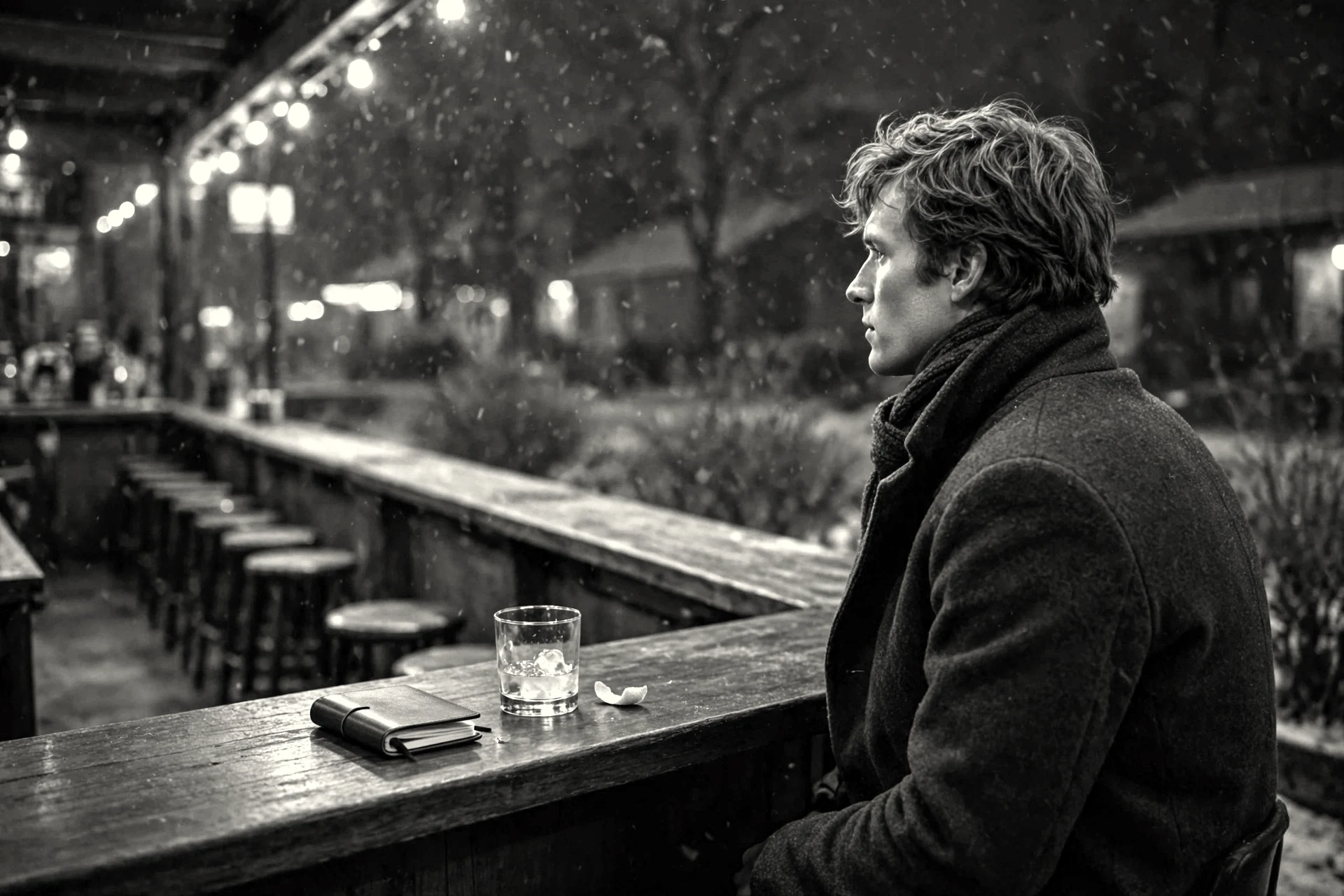
Dana saw the notebook first.
Two barstools down from Amaan, a tall man sat alone with a drink he was in no hurry about, reddish-brown hair, a face the whole planet would know turned three-quarters away, and beside his glass, square and pocket-sized and unmistakable, a notebook like theirs.
Like hers. Dana looked at the notebook, then at the profile, then at the notebook again, doing the arithmetic every person in that alley would have done and then politely undone.
“Marcus,” she said, quietly. “Two down. Is that…?”
Marcus turned, casually, the way a man turns toward weather. The stool was empty. The glass was finished, set down square on its coaster, and the notebook was gone, and the alley went on being an alley: heaters, murals, a hundred people, none of them him.
“It wasn’t,” said Marcus, mostly to himself. “It can’t have been. Here?”
Marcus asked me about it three days later, sideways, the way men ask. You would tell me, right, if that was him? And I poured his drink and said what I say, which is nothing in particular, very warmly. The code is the code. But you are not in their world, and so I will tell you what I told no one at that bar.
It was him. It is always him, in the last hour, doing the doors the way he does everything: alone, unhurried, and gone before the fuss. The houses know. The regulars know.
Nobody photographs him, nobody announces him, and the man gets to be a person in a coat with a notebook, two stools down from a loud argument about the future of the republic, exactly like anyone else. It may be the only ordinary thing fame has left him. This city lets him keep it.
An argument about a senator is never only about a senator, by the way. Marcus believes you win the way he is learning to live: you show up, you stay sweet, you finish. Amaan believes you win the way he is having to live: you stop being grateful for the invitation and you fight. Neither of them said that, obviously. They said it about Malik, at volume, with gestures, and Dana, who understood both of them perfectly, let them.
They stayed for one more than planned. That is the whole sentence and it matters more than the argument, because the extra round was Marcus’s idea, proposed out loud, in January, outside, by the man who had nearly not come to Door One. Something is happening to Marcus, one door at a time, and it is not only about finishing.
The alley emptied around them while they finished it. Chairs went up in the cold. The heaters ticked as they cooled. Amaan walked the two of them as far as the street like a host seeing guests off his own porch, shook Marcus’s hand, kissed the air beside Dana’s cheek with enormous ceremony, and announced that he would see them at Door Four, which was the first time any of them had said the next door out loud as if it were already an appointment.
Then he went back into the alley alone, to say goodnight to the bartender properly, because Amaan has never in his life left a room by the short route.
In the car, with the heater doing its best, Dana wrote the night’s line in her book under the entry, where the rules say the memories go. She did not write about the tall man, because some entries you keep behind your teeth. She wrote: Door Three. It isn’t just us anymore.
Endnote (real door, for the Journal): The Skip, 1234 The Belt, downtown Detroit. There is no door to find: the trick is finding the alley. It is an open-air bar in the middle of the Belt, the mural-covered alley off Library Street, and nothing of it is visible from the street. Walk in; no reservations, no list. Known for frozen drinks done properly, above all the frozen Irish coffee, and tropical cocktails. Open Tuesday to Thursday and Sunday 4pm to midnight, Friday and Saturday 4pm to 2am; closed Monday. The door is on the map: deadlycompany.co/detroit-speakeasy-scene/ and the challenge is open to every reader: deadlycompany.co/one-year-of-hidden-bars-and-speakeasies-tour/