 CompanyMade in Detroit | Est. 2026
34 Doors
Episode 2: The Standby

There is a man who has been drinking at my bars, on and off, for eleven years, and in all that time I have never once seen him hurry.
He is Letti’s father. You do not get his name yet. A name like his is not information, it is an inheritance, and a year like this one earns it in order, the way he would insist: properly, or not at all.
What I can give you is the face, because the face he gives everyone: dark eyes that have decided to be amused by the world, a pencil mustache kept immaculate, and beneath the lower lip a small triangle of hair, a soul patch, trimmed like a signature. A Spaniard by way of Argentina, which is a long story he deals out the way he deals out songs, rarely, and only when the room has earned one.
He told me Door Two himself, across my bar, a week later. Which means I have two versions of it. The one that happened, and the one he tells. They are the same story. His simply has better light.
He takes his coffee at my bar in the mornings, Letti’s father, at the hour when the light is still deciding, and he takes it the way a man inspects a parade he used to command.
The newspaper gets read aloud in the places where it is wrong, which is most places, and corrected, and the room, such as it is at that hour, me, the delivery man, and whoever slept badly, is improved by timetable. Once, in those first weeks, I asked him about the years before Buenos Aires, and he smiled the smile of a man closing a beautiful door, gently, from the inside.
“That one,” he said, “I am keeping. A story like that wants a room that deserves it.” I have been poured for, lied to, and confessed at by most of Detroit, and I keep his coffee the way he likes it and his story the way he keeps it: unopened.
That is the bartender’s whole profession, when you write it down. Keeping things for other people. Locking up, some nights, I count what the year has already put in my keeping, and I pour nothing for myself, and the arithmetic is not self-pity. It is inventory.
That month, a regular brought his brother-in-law in over a Thursday: money had changed hands or not, and both had been drinking. They put it to me. I said it had changed hands, before the second round, and named who counted it out. Both nodded, and the brother-in-law paid for breakfast. No paper. No appeal. That is my whole credit: unspent, like his story.
By the second week of January the morning show had run out of patience with calling them “the notebook people,” and had settled, the way radio does, on a name with a door in it. The Door People. Letti heard it in her car and phoned her father immediately, because some news is only official when he has laughed at it.
Door Two was hers to run, and she ran it the way she runs everything, like a woman defusing a calendar. The Standby. Downtown, in the Belt. Antonio, for once, was not the complication. Antonio was early.
“He was early,” Letti told me, still faintly stunned, three days afterwards. “He brought coffee. He complimented the alley.”
Letti had a reservation, of course. She had a reservation, a route timed to the minute, and a plan for the walk back to the car that made allowances, I believe, for the weather.
Her father, who once crossed two continents with a guitar and no plan whatsoever, regards her system the way a river regards a bridge: with respect, and no intention of using it. “My daughter,” he told me once, “could organize a revolution by Thursday. She already has the notebooks.”
The Standby has no street entrance and no sign, which is the sort of thing that makes most people walk past it twice. You come into the Belt, the alley the city dressed up and taught manners, and you find a door set into an old elevator shaft, and that is the whole invitation.
Her father stopped in front of it and stood there, in the cold, with his hands in his coat pockets, regarding it the way a man regards an old friend who has done well.
“A door that hides,” he said, “is a door with manners.” He bowed to it slightly. Letti would like the record to show that he bowed to a door. “After you, mi hija. A shaft, in my day, was how a man left a building quickly. Tonight we use it to arrive.”
Inside, it is a proper room: a full bar, a chef’s kitchen working behind it, the warm low hum of people who have dinners to get to and are in no rush at all, half of them bound for the Opera House eventually.
Antonio was already known to the host by the time they sat down, which should have been impossible, since he had arrived four minutes earlier. He had learned the bartender’s name, used it twice, correctly, and somehow, without a single visible manoeuvre, the three of them had the seats everyone else in the room was pretending not to want.
“Five minutes,” said Letti, when the drinks had come. “For five minutes, nobody performs. No stories. No charming the furniture. The door can do the work tonight.”
“Mi hija,” said her father, “I am an old man in a chair. Sitting is my entire repertoire.”
“And I,” said Antonio, “am a husband at dinner. I can be ordinary for five minutes.”
He was magnificent for nineteen seconds. Then the shaft door opened behind him, and Antonio checked it without deciding to, the way other men check a watch, and was on his feet before the host was, greeting them like the house’s ambassador.
“Nineteen seconds,” said her father. “A personal best, I think.”
Letti laughed, and meant it, and did not get her five minutes.
This is the thing about Antonio that the year will make complicated, so I want it down plainly, in January, where it belongs. None of it was a performance laid over the marriage. It was the marriage, on a good night, working exactly as designed. He ordered for the table and got all three orders right, including her father’s, whom he has been getting right for years.
He asked the old man about Argentina and then did the rarest thing a charming man can do: he listened all the way to the end of the answer. Letti laughed twice with her whole face. Her father watched the two of them the way a man watches weather he approves of.
Her father told me that evening himself, across my bar, and he told it as a comedy, which it was. But a man tells on himself in the seasoning, if you pour for a living.
Laughing, he said Antonio had known the bartender’s name inside four minutes, and the other thing too, the thing the boy does with his eyes when a door opens behind him: he checks it the way you or I would check a watch, without deciding to. “A room cannot surprise him,” her father said, delighted.
“I have not been in a room that could surprise me since I was nineteen.” He said it as a resemblance, and as the highest compliment in his possession, and set his cup down pleased with the pair of them. I have thought about that sentence more than any other sentence of the winter.

“In Buenos Aires,” he said, settling, when the drinks had come, “there was a club you entered through a tailor’s shop. You stepped into the fitting room, and the tailor, who had measured kings and assassins with the same tape, would look you over and decide which man you were.
Then the mirror opened.” He tasted his drink, something short and dark, and nodded at the bartender like a colleague. “I was always measured as the romantic. It was the mustache. A mustache is a promise a man makes to strangers.”
“Was it true?” said Letti. “Any of it?”
“Every word,” he said, “is true in the important places.” He raised his glass to the elevator shaft behind them. “A door that hides is a door that trusts you to look. Detroit understands this. It is a city of tailors.”
The bartender signed their three pages in turn, unhurried, a man who had signed a dozen that week and would sign a dozen more. Letti pressed her ring first, brisk, a seal on a treaty: a coaster ring print from a wet glass.
Antonio did his with a flourish that somehow stayed elegant. Then her father, who took the glass in both hands like a chalice and set his mark down dead center of the page, with the concentration of a man signing a treaty of his own.
“Door Two,” he said, “entered through a lift shaft, in an alley, in January.” He looked around the warm room with open delight. “If the year insists on being like this, I shall be forced to enjoy it.”
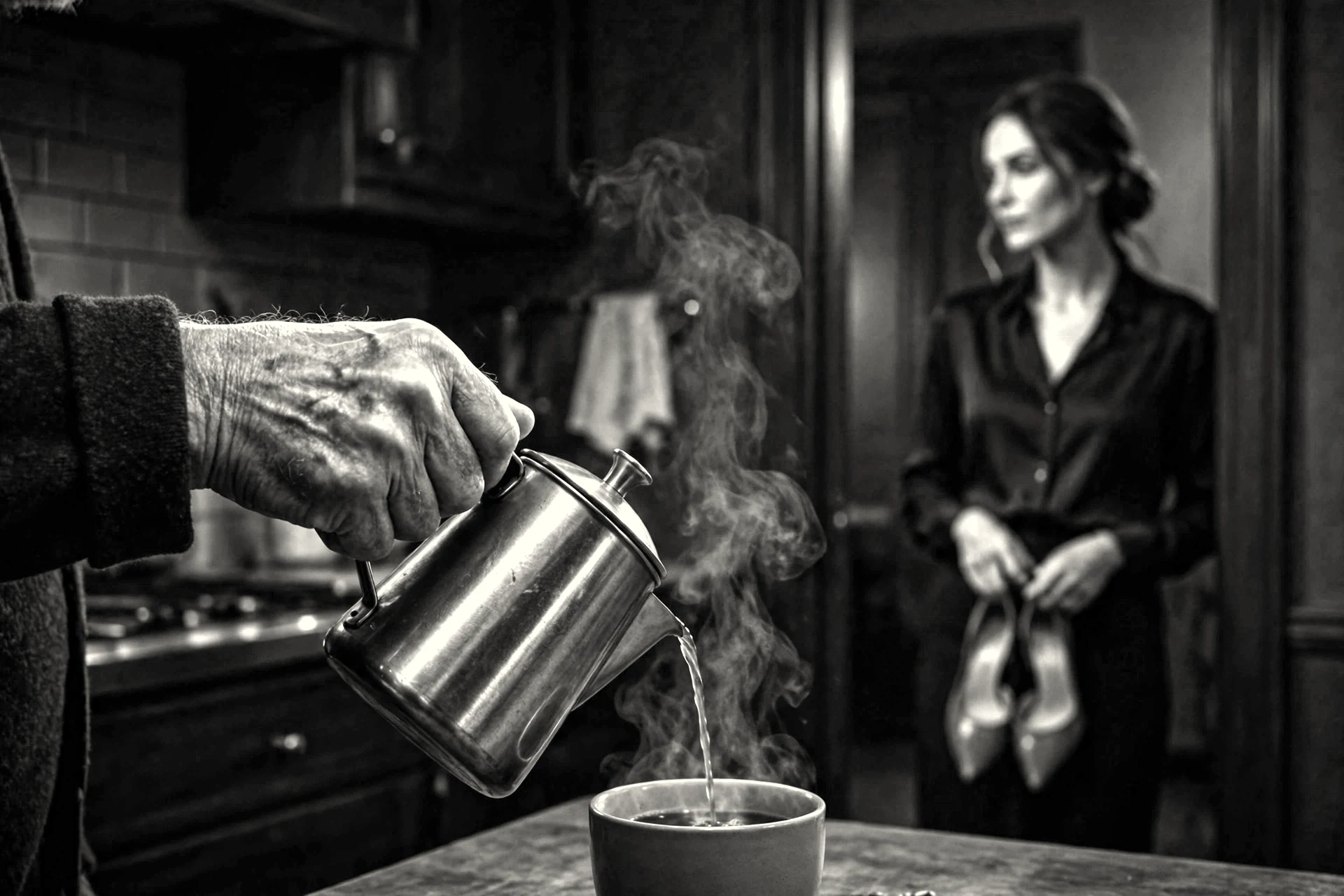
The coffee was his department, back at his house, the way it has always been his department. Letti had driven him home through the empty streets, and the house was cold in the particular way of houses that have been out all evening, and he would not sit down until the pot was on. She watched him from the kitchen doorway, tired, happy, her shoes in her hand.
He poured. And his hand, which had held a glass like a chalice an hour before and set a ring dead center of a page, shook on the pot, so that the coffee trembled in the stream and clicked the rim of the first cup.
He saw her see it. A man who has been read by experts all his life does not miss being read by his daughter.
“Cold,” he said, lightly, and poured the second cup steady, out of what looked very much like pride. “An old house, mi hija. January gets into the pipes.”
She filed it under cold. It was the second time she had filed it there. The first was Thanksgiving, over the same man’s coffee, at the other end of the winter, and she had believed it then because the room was full and the day was loud.
She believed it now because he had handed it to her like a gentleman, and because the alternative was a sentence she was not going to say in his kitchen at midnight. The reader, who has no such manners, may start a file of their own.
What a daughter files and what a father knows are two different archives.
When she had gone, and the house had settled, he stood a while in his kitchen with the second cup cooling in front of him, and looked at his right hand where it rested on the counter, flat, still, a hand that had done everything he had ever asked of it, in three countries, in two trades he did not discuss, across a longer life than his daughter yet knew about.
It trembled, very slightly, against the wood. He watched it the way he would watch weather coming in over a border: without surprise, and without the slightest intention of mentioning it to anyone.
He had held worse things steady in worse years, in the rain, with considerably less notice.
He filed it, as his daughter had, under cold. It was January in Michigan. It was even true.
It was simply not all of it.
Endnote (real door, for the Journal): The Standby, 225 Gratiot Ave (The Belt), downtown Detroit. There is no street entrance and no sign: come in from the Belt alley, through the door set in an old elevator shaft. A full cocktail bar and restaurant, with a chef-driven kitchen and a longtime following among the Opera House crowd before a show. Reservations are encouraged via OpenTable; walk-ins are welcome, and the bar itself is first come, first served. Open Wednesday, Thursday and Sunday 5pm to 1am, Friday and Saturday 5pm to 2am; closed Monday and Tuesday. The door is on the map: deadlycompany.co/detroit-speakeasy-scene/ and the challenge is open to every reader: deadlycompany.co/one-year-of-hidden-bars-and-speakeasies-tour/